
For healthcare legal counsel, Chief Information Security Officers (CISOs), and compliance gatekeepers, third-party vendor risk management is no longer a routine checklist item—it is an enterprise liability priority. With healthcare data breach costs exceeding an average of $10.93 million per incident—the highest of any industry for over a decade according to the IBM Security Cost of a Data Breach Report—extending operational access to external Business Associates frequently triggers intense risk-mitigation scrutiny.
The fear among healthcare leaders is justified: traditional BPO vendors operating with local device storage, persistent user sessions, or unmonitored network connections represent catastrophic exposure points under modern cyber threat vectors. However, restricting operational scale due to security fears creates a different enterprise vulnerability: administrative stagnation.
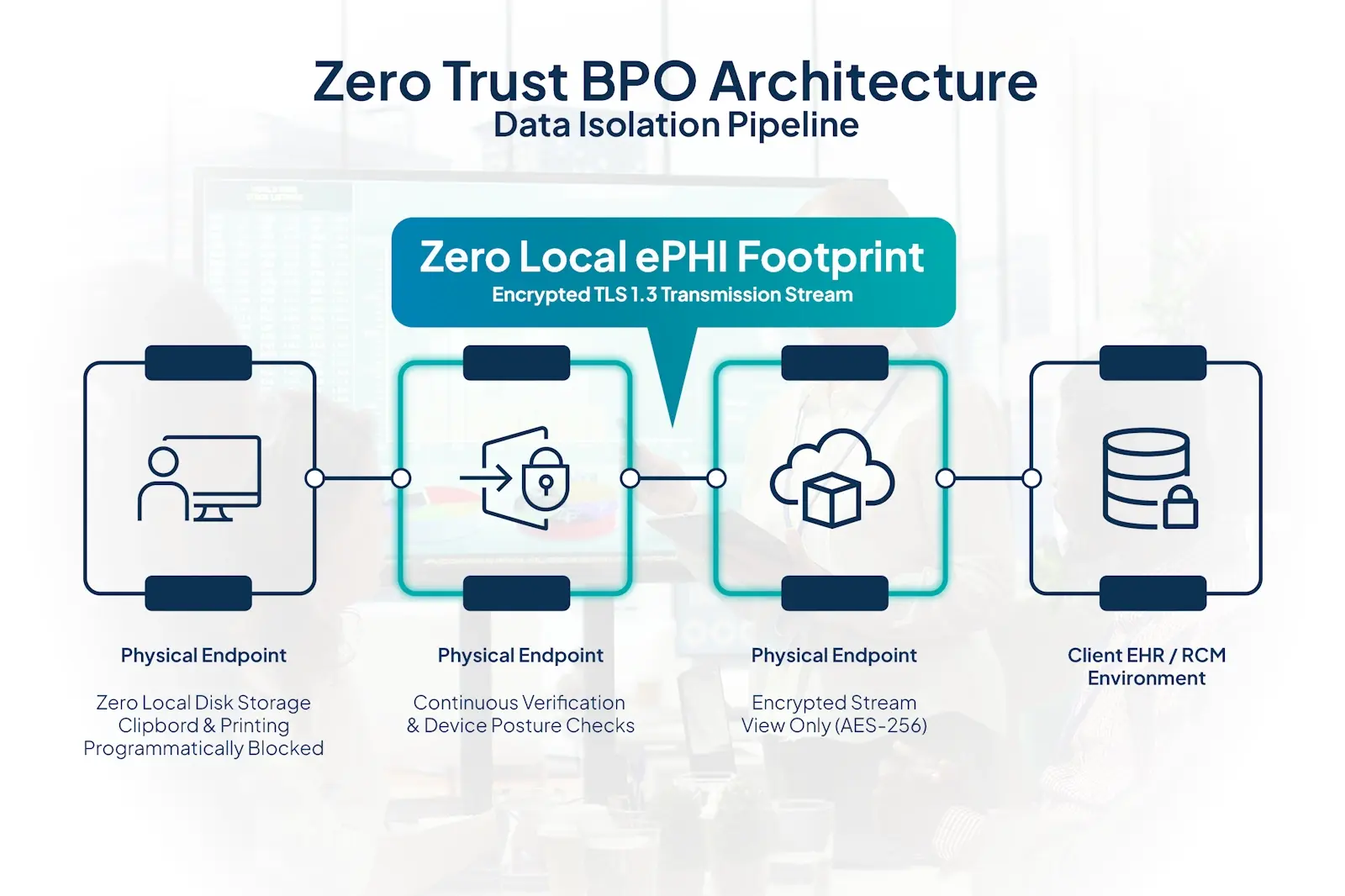
To safely scale back-office workflows, medical networks are adopting Zero Trust BPO Architecture: an advanced technical safeguard model that eliminates local data exposure, enforces continuous verification, and completely isolates electronic Protected Health Information (ePHI).
The Liability of Traditional Vendor Outsourcing
In legacy business process outsourcing models, data security relies heavily on policy enforcement—hoping remote or off-site personnel adhere to security protocols on local workstations. However, the HHS Office for Civil Rights (OCR) Enforcement Portal demonstrates that policy alone is insufficient against modern cyberattacks, unauthorized downloads, or credential compromise.
When third-party contractors store ePHI locally, utilize static VPN tunnels, or maintain broad database permissions, every endpoint becomes a potential attack surface. Under strict HHS HIPAA Technical Safeguards, covered entities remain legally accountable for security failures introduced by their vendor ecosystem. De-risking vendor partnerships requires shifting from policy-reliant security to technical architectural prevention.
Ephemeral VDI & Data Isolation: Eliminating the Local Data Footprint
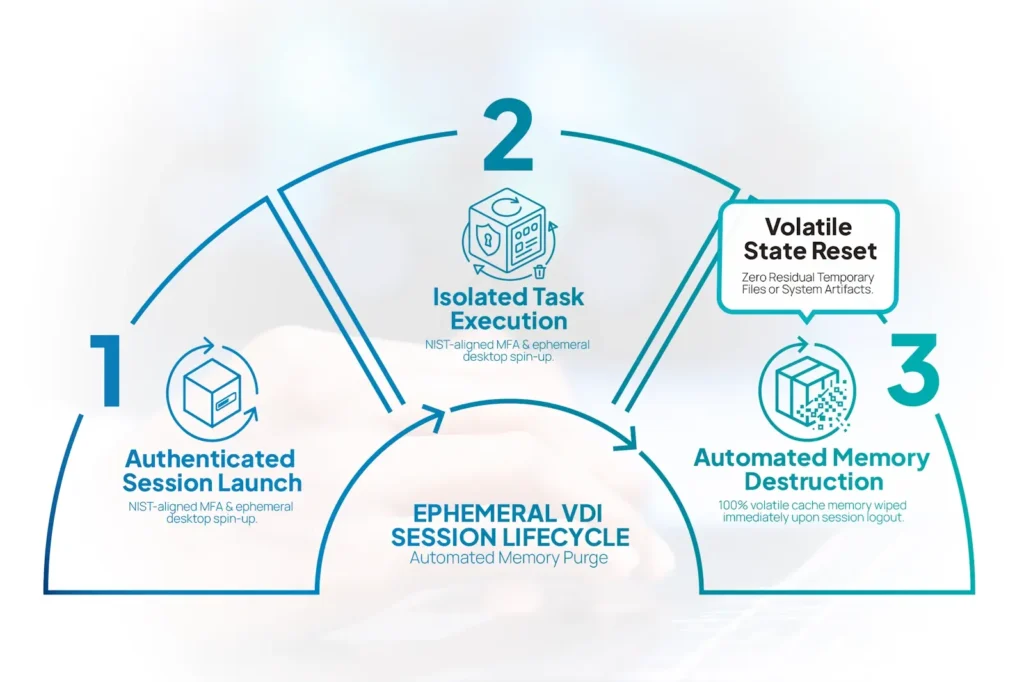
Modern Zero Trust architecture centers on a single imperative: preventing ePHI from ever residing on endpoint devices. A prime example of this philosophy in enterprise IT is Ephemeral Virtual Desktop Infrastructure (VDI)—a framework where operational tasks are executed within temporary, cloud-hosted virtual environments rather than local machines.
Whether enforced through ephemeral VDI or strict cloud-based data isolation protocols, the Zero Trust threat model fundamentally alters security:
- Zero Local Data Storage: ePHI is accessed strictly through secure, encrypted streams. No clinical data, patient records, or financial files ever download to or reside on the physical hard drive of an operational specialist.
- Volatile Session Lifecycles: In ephemeral frameworks, virtual environments generate dynamically upon authenticated login and wipe completely upon logout, leaving zero cached memory or temporary system state for attackers to exploit.
- Restricted Data Egress: Physical USB transfers, local printing, clipboard copy-pasting, and unauthorized external screen captures are disabled at the system level within secure operational environments.
Granular Role-Based Access Control (RBAC) & Continuous Verification
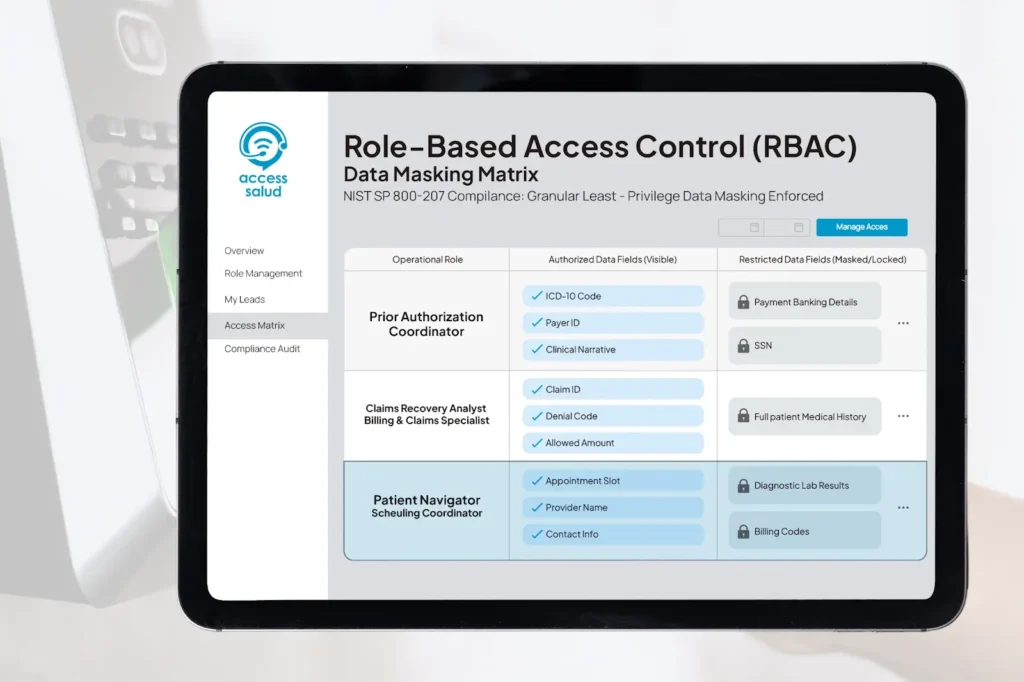
In alignment with NIST SP 800-207 Zero Trust Architecture Guidelines, modern healthcare BPO environments operate under a strict policy of “Never Trust, Always Verify.” Access privileges are never granted broadly across an organization; instead, they are strictly governed by Role-Based Access Control (RBAC) and Least-Privilege Principles.
Operational specialists are granted access strictly to the exact fields and modules necessary to execute their designated tasks—such as prior authorization tracking or claims status verification—and nothing more. Multi-factor authentication (MFA), contextual device posture checks, and continuous session monitoring run invisibly in the background. If an anomalous access pattern or geographic deviation occurs, the session is instantly severed, protecting the clinical network from credential hijacking.
De-risking Scale for Legal and Compliance Gatekeepers
For healthcare executive leadership, partnering with a vendor committed to Zero Trust principles transforms security from a growth barrier into a competitive advantage. By enforcing strict data isolation, continuous verification, and granular access limits, healthcare networks achieve operational scalability without expanding their regulatory attack surface.
When evaluating third-party vendor risk management, legal counsel and compliance officers require technical safeguards that enforce security automatically. Through continuous identity verification, encrypted data transmission, and strict RBAC protocols, Access-Salud delivers elite administrative support while maintaining uncompromised alignment with HIPAA technical compliance standards.
To evaluate how our Zero Trust data security architecture and strict HIPAA technical safeguards can de-risk your outsourced back-office operations, contact us today to coordinate a technical briefing with our Compliance and Security Team