In healthcare administrative operations, operational precision is a direct function of neurobiological readiness. Back-office specialists handling prior authorizations, revenue cycle auditing, and complex clinical intake process thousands of discrete data points daily. While traditional operational management views human error as a personal oversight or training deficiency, neuroscientific research demonstrates that a primary driver of administrative inaccuracy is circadian disruption and degraded sleep quality.
Understanding the direct biological link between circadian misalignment, sleep debt, and operational error rates allows organizations to move from reactive quality assurance to proactive fatigue risk management—protecting both specialist well-being and enterprise data integrity.
The Circadian Architecture of Human Performance
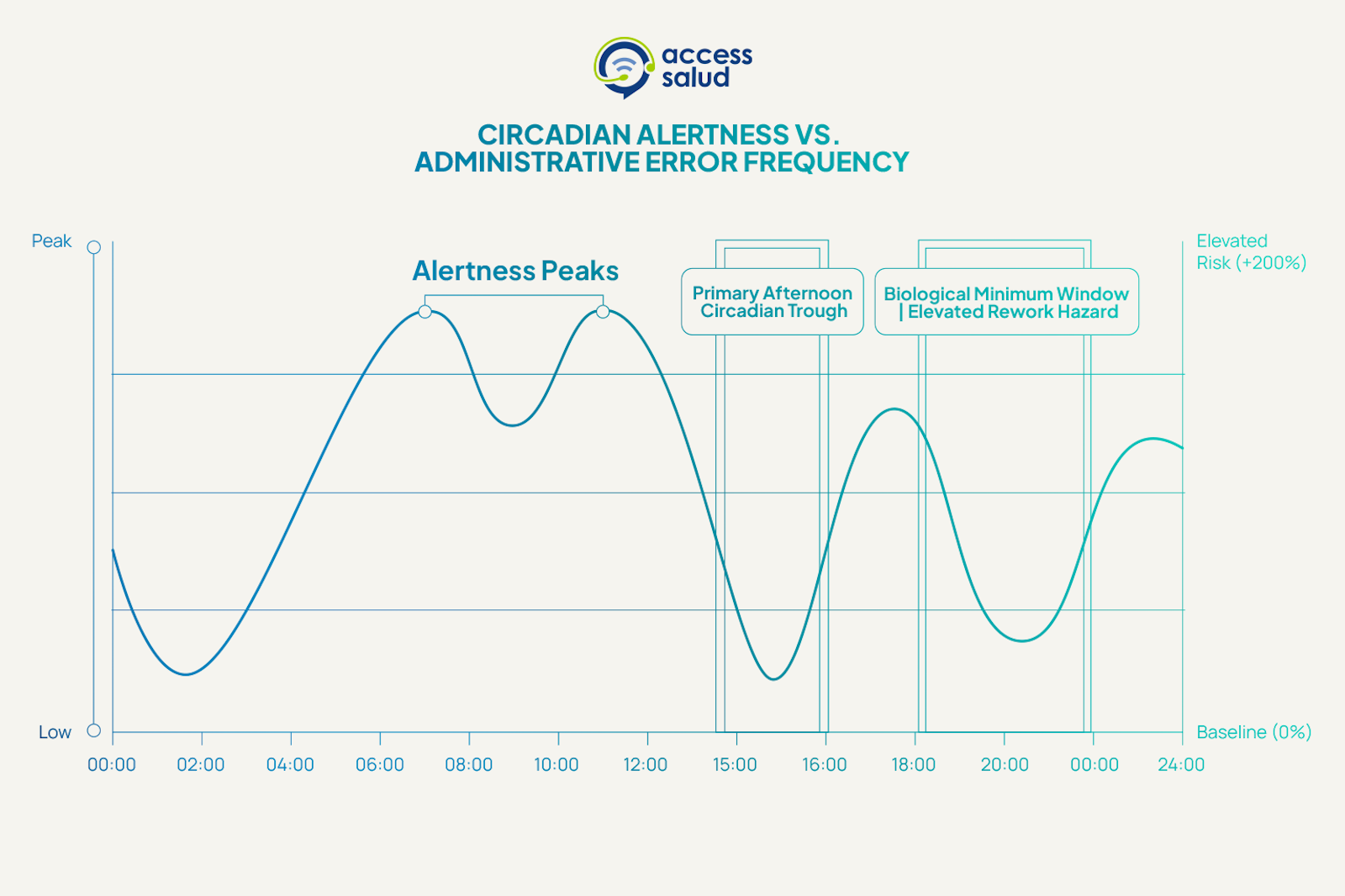
Human cognitive performance is governed by the master circadian pacemaker located in the suprachiasmatic nucleus (SCN) of the brain. This biological clock regulates cycles of alertness, core body temperature, hormone secretion, and prefrontal cortex reactivity across a 24-hour period.
When work patterns or poor sleep hygiene disrupt this natural cycle, the brain experiences a decay in executive functioning:
- Attentional Lapses & Microsleeps: As documented by research published in PMC Neurocognitive Consequences of Sleep Deprivation, sleep debt leads to progressive neurobehavioral instability. These manifest as brief, uncontrollable attentional lapses—frequently resulting in missed data fields or inverted numerical entries during routine administrative tasks.
- Working Memory Impairment: Executive functions such as working memory and processing speed rely heavily on prefrontal cortex integrity. Sleep-deprived specialists require longer processing time to verify complex clinical coding rules, leading to higher cognitive friction and increased error rates.
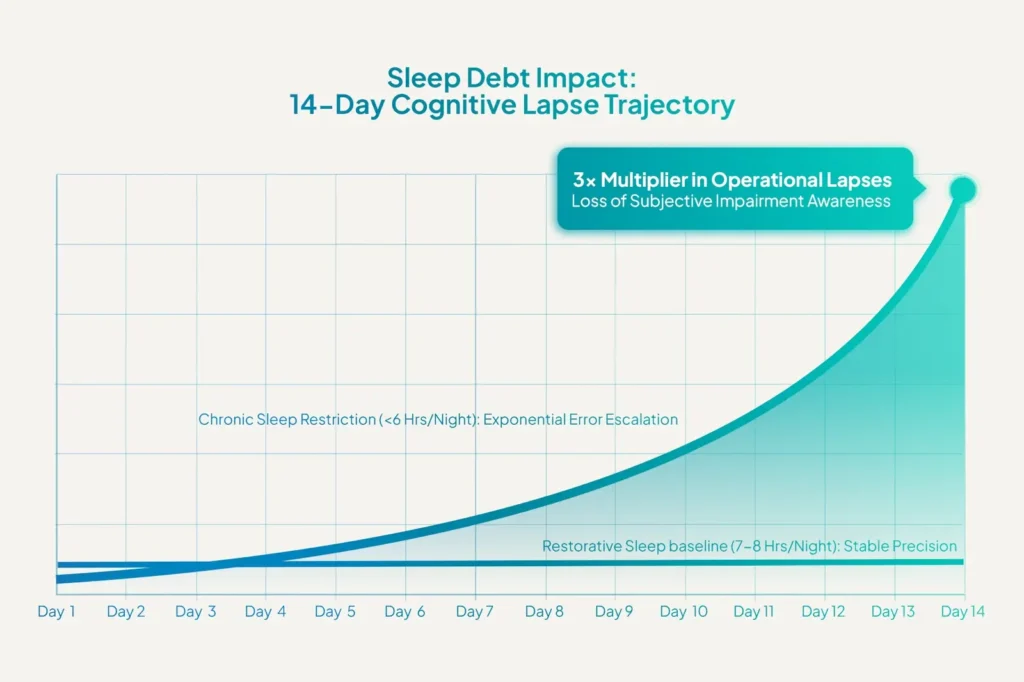
- Subjective Awareness Paradox: A critical insight from cognitive sleep research is that individuals experiencing chronic sleep restriction quickly lose subjective awareness of their cognitive impairment. While specialists may feel “adapted” to 5 or 6 hours of sleep, their objective error frequency continues to compound.
Technical Data: Quantifying Sleep Quality and Error Escalation
The impact of sleep quality on operational precision is measurable across several physiological and operational metrics:
- 3x Multiplier in Operational Lapses: Controlled clinical trials analyzed by Harvard Medical School demonstrate that individuals with chronic sleep restriction (<6 hours per night) exhibit more than a 34% to 63% drop in preventable error rates when work hours and sleep schedules are stabilized to align with healthy biological rest limits.
- Circadian Trough Vulnerability: According to the CDC NIOSH Science Bulletin on Sleep and Work, cognitive performance reaches a natural biological trough between 2:00 AM and 6:00 AM, as well as a secondary afternoon dip between 1:00 PM and 4:00 PM. During these windows, unmanaged fatigue increases operational risk factors and administrative rework costs exponentially.
- Equivalent Impairment Metrics: Studies cited by the Sleep Foundation highlight that prolonged wakefulness exceeding 17–19 hours degrades psychomotor vigilance and reaction accuracy to levels equivalent to a Blood Alcohol Concentration (BAC) of 0.05%, doubling the rate of manual data entry oversights.
Integrating Circadian Optimization into Administrative Workflows
To safeguard operational quality while supporting employee health, modern operations must incorporate circadian awareness into daily workflow design:
- Strategic Cognitive Scheduling: High-complexity tasks—such as financial denials analysis or clinical appeals—should be mapped to peak morning circadian alertness windows, reserving lower-complexity administrative archiving for natural circadian recovery lulls.
- Restorative Sleep Hygiene Standards: Educating administrative teams on circadian lighting, consistent sleep-wake schedules, and wind-down protocols directly improves sleep efficiency and daytime alertness.
- Active Fatigue Mitigation: Implementing micro-breaks, ergonomic movement interventions, and optimized workspace lighting mitigates afternoon cognitive dips and protects error-free execution.
Well-being as an Operational Safeguard
At Access-Salud, operational discipline is rooted in respecting human physiology. Promoting restorative sleep habits and designing circadian-aligned workflows is not simply an employee benefit, but an essential operational strategy that eliminates rework, protects provider partner relationships, and fosters a sustainable work culture.