

In the complex ecosystem of healthcare administration, success is rarely the result of isolated heroics. True scalability—the kind that securely manages thousands of patient interactions and complex revenue cycles—requires a shift from individual task management to synchronized team architecture.
A high-performing healthcare support team does not just execute; it engineers a continuous, seamless workflow. When standard operating procedures are clearly defined and automated systems are embraced, a group of specialists transforms into a unified engine of growth.

Synchrony: The Ultimate Antidote to Response Delays
In our daily operations, time is a critical clinical and financial metric. The speed at which a patient is navigated, a prior authorization is cleared, or a complex claim is recovered directly impacts the health of the practices we support.
Achieving rapid, accurate response times is only possible through deliberate teamwork. When front-office staff, care management coordinators, and data analysts operate within documented, autonomous workflows, the operational friction between identifying a problem and delivering a solution disappears. The effort of our people is magnified when every individual understands exactly how their specific role connects to the next stage of the pipeline. This synchrony ensures that no task is dropped, no patient is left waiting, and no revenue is lost in transition.
Shielding Workflows from the Unexpected
The healthcare industry is inherently unpredictable. Volume spikes, sudden regulatory shifts, and unexpected technical disruptions are standard realities.
What separates a fragile operation from a resilient one is how the team absorbs these shocks. By prioritizing the creation of robust legacy systems—comprehensive documentation, clear escalation protocols, and cross-trained support structures—our teams create an operational shield. When the unexpected occurs, the architecture holds. Rather than reacting with improvised panic, a high-performing team leans on its shared systems, allowing for a calm, methodical, and uninterrupted delivery of service. This level of resilience is a testament to the daily, meticulous effort of our staff to build processes that outlast any single challenge.
The External Impact of Internal Alignment
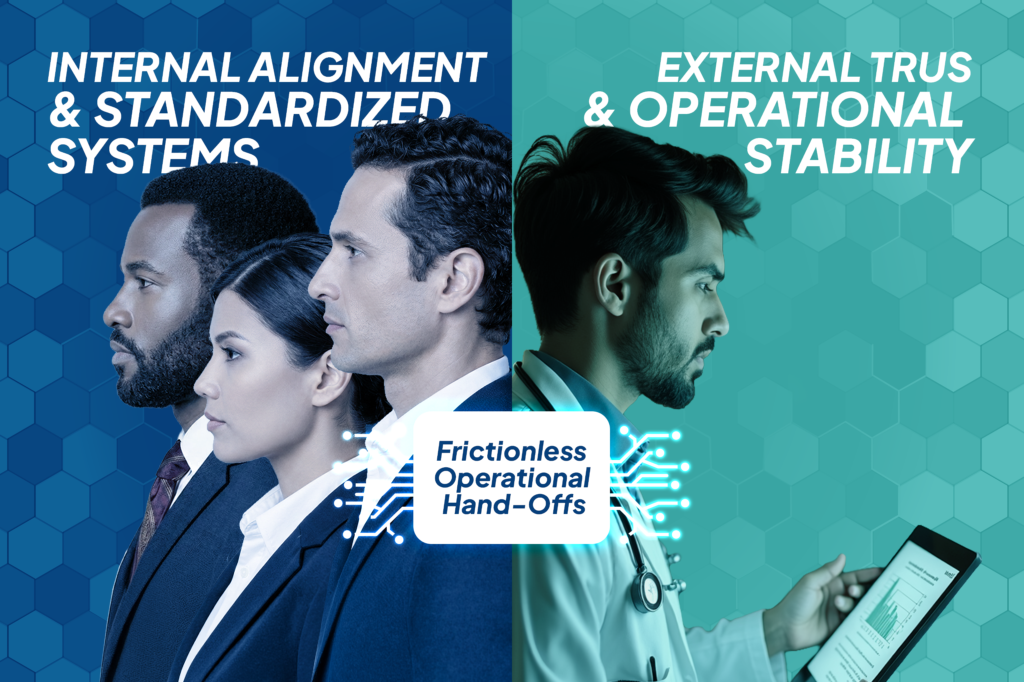
While our operational architecture is built internally, its effects are immediately felt externally. When U.S.-based medical groups and clinical leaders partner with Access-Salud, they are not just looking for administrative relief; they are looking for stability.
Every interaction our team has with a client, provider, or patient projects our internal reality. When a client witnesses seamless handoffs between our departments, proactive problem-solving, and rapid communication, that internal alignment translates directly into external trust. They perceive a partner that is cohesive, disciplined, and deeply invested in the mission.
Engineering the Future of Care
Operational excellence is not an accident. It is the deliberate result of professionals choosing to work in harmony, continuously disrupting inefficiencies, and prioritizing high-value outputs over rigid routines. The strength of our organization lies entirely in this collective effort. By building coordinated systems and moving forward as one synchronized unit, we are not just managing healthcare processes; we are actively architecting the future of healthcare growth.