
The Escalating Financial Risk of Payer Adjudication
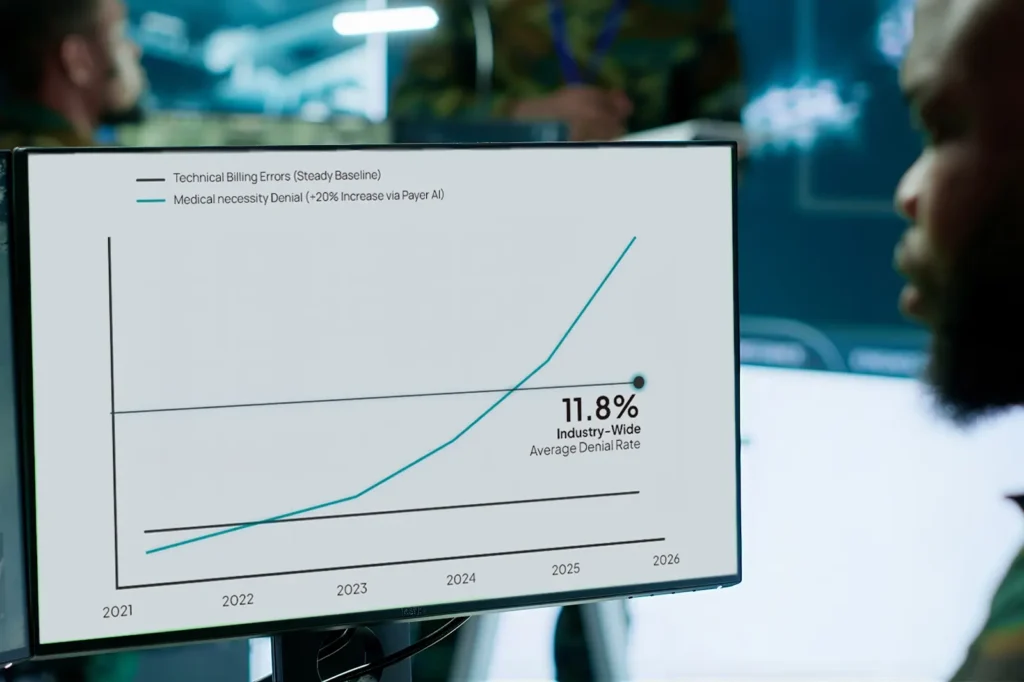
In the 2026 revenue cycle landscape, managing insurance rejections has evolved into a core financial challenge. Driven by payers adopting automated, algorithmic review engines, initial claim denial rates have climbed to an industry-wide average of 11.8%. Research indicates that payer behaviors and shifting adjudication guidelines have officially surpassed internal issues like staffing to become the single largest risk to provider revenue growth.
With 62% of revenue cycle management (RCM) executives identifying claims denials as their top operational obstacle this year, treating all rejections with a uniform approach is no longer sustainable. To maximize recovery margins and reduce days in accounts receivable (AR), practices must separate their workflows based on a clear, data-driven understanding of the difference between clinical and technical denials.
Defining the Divide: Clinical vs. Technical Denials
What is a Technical Denial?
A technical denial (also referred to as an administrative or clerical denial) is an insurance claim rejection issued by a payer due to programmatic, data formatting, or policy non-compliance errors rather than the nature of the medical care provided. Common causes include missing or incorrect modifiers, patient eligibility mismatches, timely filing breaches, duplicate submissions, or lack of required prior authorizations. Because these rejections are based on explicit, quantifiable rules, they can be easily addressed or prevented through automated technology and front-end claim scrubbers.
What is a Clinical Denial?
A clinical denial is an insurance claim rejection issued following a medical review, where the payer determines that the rendered services do not meet established medical necessity criteria, coverage rules, or level-of-care standards. Common causes include disputes over inpatient versus outpatient observation status, length-of-stay challenges, and Diagnosis-Related Group (DRG) downgrades. Unlike rule-based technical rejections, clinical denials cannot be resolved by software alone; they require human reasoning, comprehensive clinical chart review, and detailed appeals authored by qualified healthcare professionals.
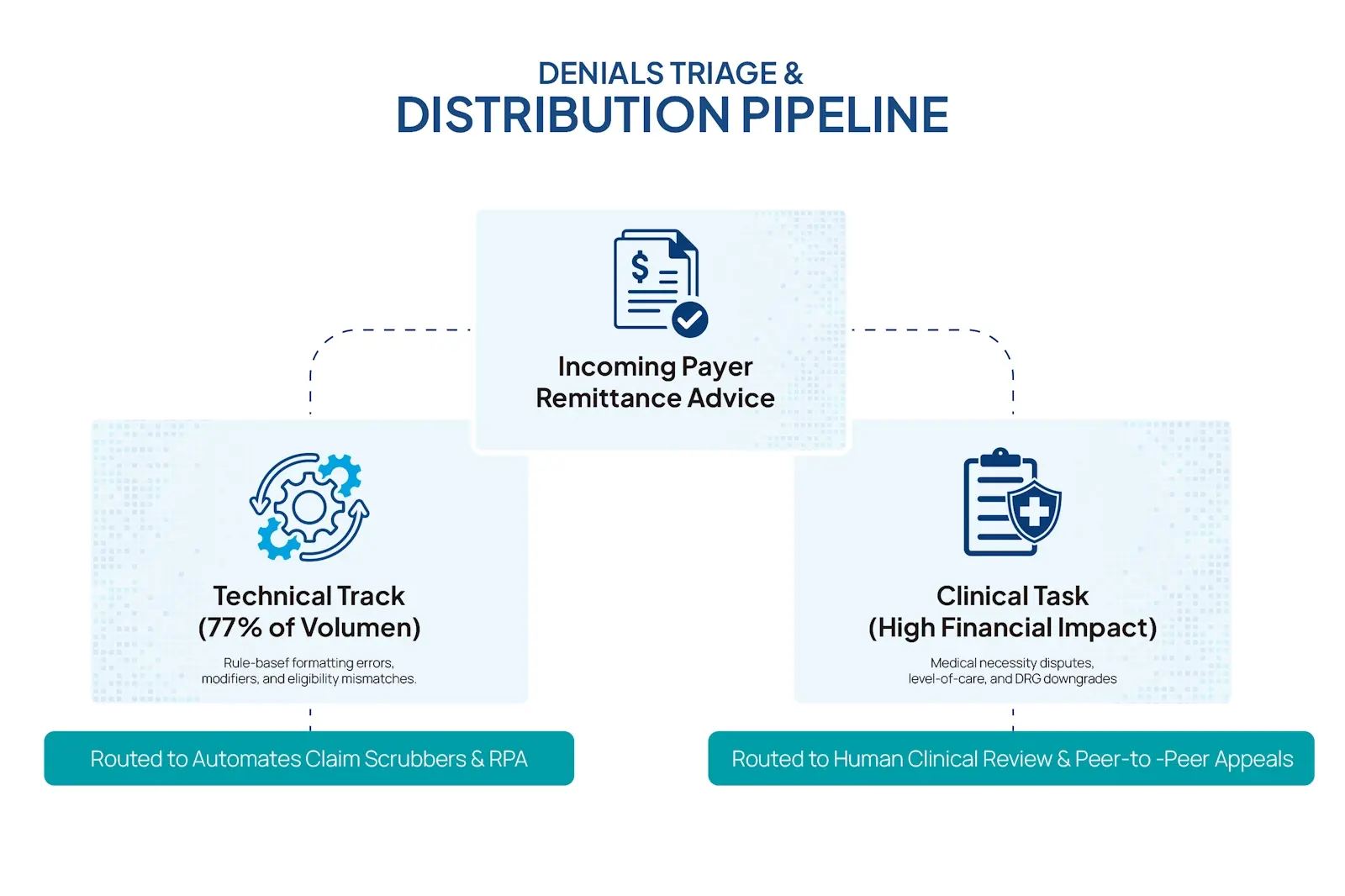
[Incoming Payer Denials Pipeline]
│
─────────────────────────┴─────────────────────────
▼ ▼
[Technical Track] [Clinical Track]
Rule-Based / Formatting Error Medical Necessity / DRG Dispute
│ │
▼ ▼
Robotic Process Automation (RPA) Human Clinical Chart Review
& Automated Resubmission & Peer-to-Peer Appeal Advocacy
Automating Technical Recovery: Optimizing the Digital Processing Track
Technical denials represent approximately 77% of all initial insurance rejections, making the vast majority of billing errors entirely preventable. Because these rejections depend on clear-cut logic checks, such as verifying whether an intake coordinator transposed a digit in a patient’s insurance ID, relying on manual human tracking is an inefficient use of resources.
Managing technical recoveries in 2026 relies heavily on automated rule validation. By utilizing automated claim scrubbers and real-time eligibility clearinghouses, patient access teams can catch administrative errors before the claim is ever submitted to the payer. Any technical rejections that slip through can be handled by automated workflows that identify the missing data point, apply the correct billing modifier, and resubmit the claim without requiring manual intervention from front-office staff.
Overcoming the Clinical Medical Necessity Chokepoint
While technical errors represent the highest volume of rejections, clinical denials are far more complex and financially damaging. Driven by payer-side AI decision tools, medical necessity denials have increased by 20% since 2021. Payers routinely deploy rapid algorithms to deny high-complexity inpatient stays, pharmaceutical coverages, and advanced diagnostic therapies.
Overturning a clinical denial requires a deep, professional evaluation of clinical records. An automated rule engine cannot formulate a nuanced argument to defend a physician’s clinical judgment. Resolving these disputes requires a specialized, clinical team who can analyze unstructured EHR notes, extract supporting clinical documentation, and lead successful peer-to-peer appeal conversations.
Building a Dual-Engine Claims Recovery Framework
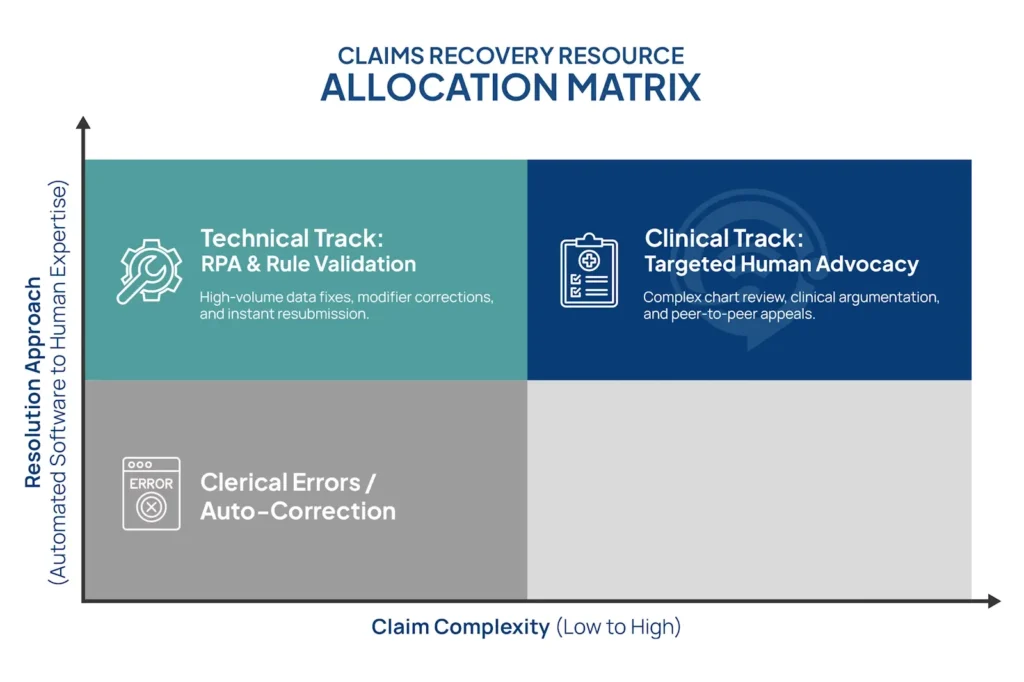
Maximizing cash flow predictability requires splitting your denials management into two distinct, coordinated pipelines:
- The Automated Technical Loop: Route all administrative, data, and formatting errors to automated systems to ensure instant corrections and protect internal staff time.
- The Expert Clinical Loop: Direct all medical necessity, documentation gap, and level-of-care disputes to a dedicated patient navigation team capable of managing complex clinical appeals.
This specialized division of labor ensures that administrative staff are not bogged down by complex medical reviews, while clinical specialists are completely insulated from simple data entry tasks. By matching technical automation with targeted human advocacy, healthcare organizations can effectively protect their revenue cycle from structural payer friction.
Transforming Denials Management Into a Core Growth Asset
Sustaining operational growth under modern payer models requires moving past reactive claims management. Protecting your bottom line from the rising tide of automated rejections requires a clear operational framework that treats data errors and clinical disputes as completely separate challenges.
By automating technical billing processes and deploying dedicated clinical specialists to manage medical necessity appeals, forward-thinking medical practices can reduce their overall denial rates, secure revenue for services already performed, and ensure their internal teams remain focused on patient care.