The Operational Paradox of High-Value Reimbursement
The transition from fee-for-service to value-based care (VBC) models was designed with an idealistic dual promise: improve patient outcomes while lowering the systemic cost of delivery. Under accountable frameworks, clinical revenue is directly tied to a network’s ability to demonstrate performance across standardized clinical quality benchmarks, preventive screenings, and population health parameters.
However, this transition has introduced a massive operational paradox for healthcare executives and chief operating officers. While value-based care seeks to incentivize wellness, the backend execution has created an unprecedented data collection crisis. Medical practices are frequently transforming highly trained clinical providers into data-entry specialists. This heavy focus on checking boxes, closing care gaps, and managing quality reporting networks has shifted focus away from direct patient interactions, threatening to pull medical teams under a wave of administrative fatigue.
The Data Dilemma: MIPS, HEDIS, and the Hidden Administrative Strain
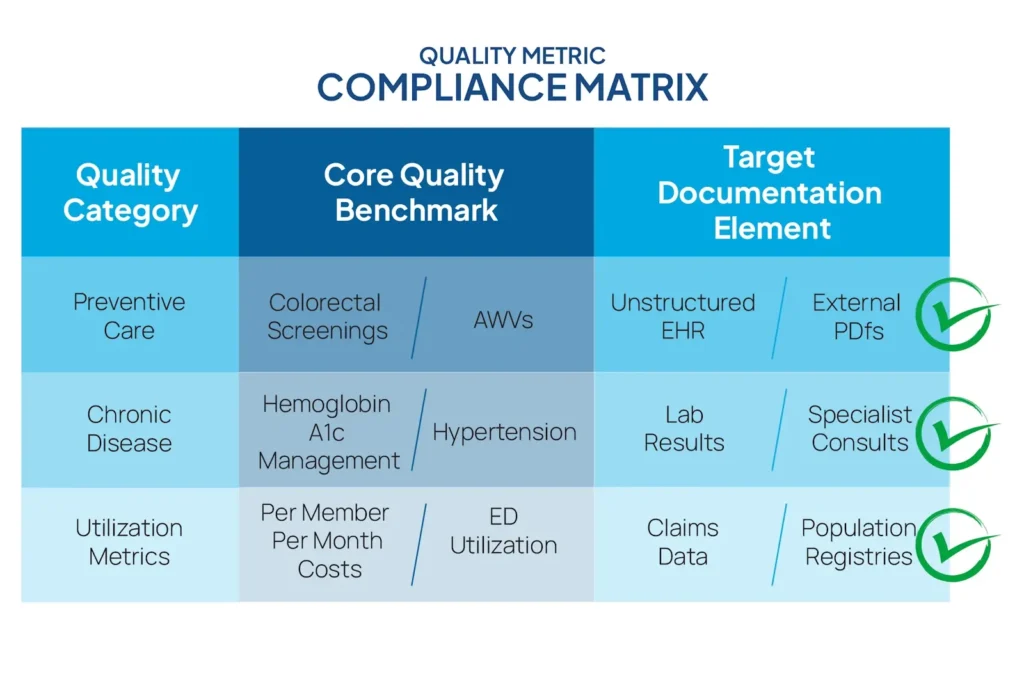
To capture maximum shared savings or avoid steep regulatory penalties, operations leaders must track hundreds of discrete variables across different payer frameworks. Whether managing the Merit-based Incentive Payment System (MIPS) for Medicare or navigating the Healthcare Effectiveness Data and Information Set (HEDIS) for commercial insurers, the data requirements are immense. Teams must constantly track preventive care compliance—such as colorectal screenings, annual wellness visits (AWVs), and hemoglobin A1c management—alongside utilization metrics like Per Member Per Month (PMPM) costs and emergency department utilization.
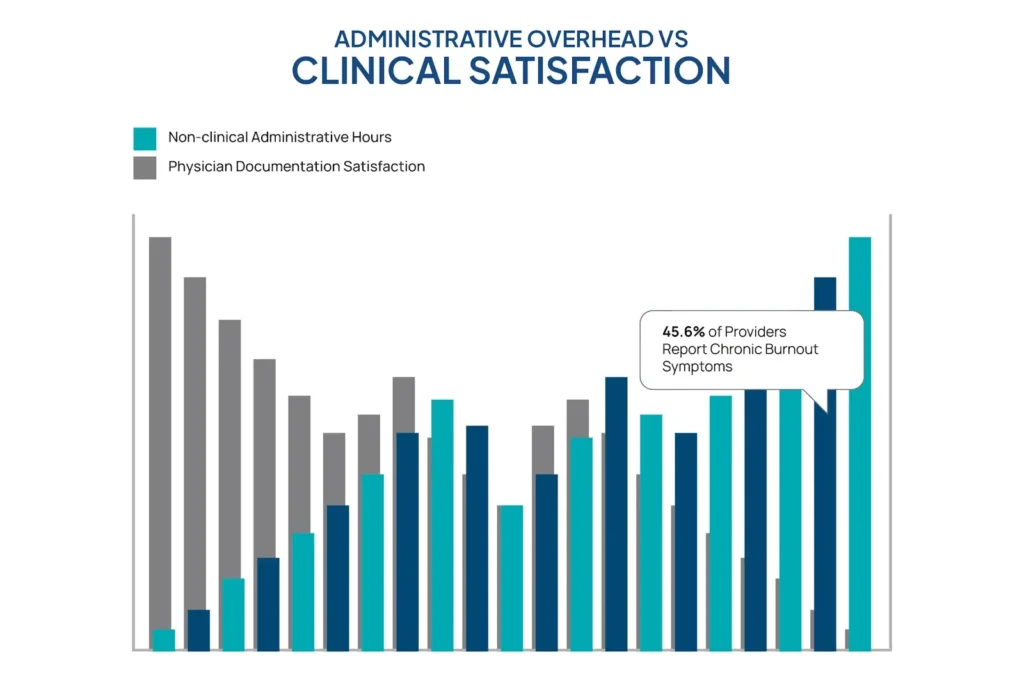
The downstream cost of manually extracting this documentation from unstructured Electronic Health Record (EHR) files is staggering. Recent data from national wellness assessments indicates that despite incremental multi-year improvements, 45.6% of physicians still report chronic symptoms of professional burnout, with excessive administrative tasks cited as a primary driver of operational stress. When clinics lack dedicated data extraction and chart abstraction support, the financial consequences are severe: physician turnover and forced work-hour reductions cost the United States healthcare system an estimated $4.6 billion annually.
[The Manual VBC Reporting Loop – High Overhead]
Patient Encounter ──> EHR Documentation ──> Manual Doctor Chart Review ──> Data Fatigue & Attrition
│
└──> Missed Care Gaps ──> Lower Quality Scores
[The Optimized BPO Care Navigation Framework]
Patient Encounter ──> Structured Intake ──> Remote Chart Abstraction ──> 100% Care Gap Visibility
│
└──> Targeted Outreach ──> Maximize Shared Savings
Decoupling Care from Data Entry: An Automated Pipeline Strategy
To survive under risk-bearing contracts without driving away clinical staff, medical groups must decouple the act of delivering clinical care from the administrative machinery of data extraction. Protecting workforce capacity requires a deliberate operational pipeline where software tools are supported by specialized administrative teams. This ensures data flows smoothly without relying entirely on the provider’s keyboard.
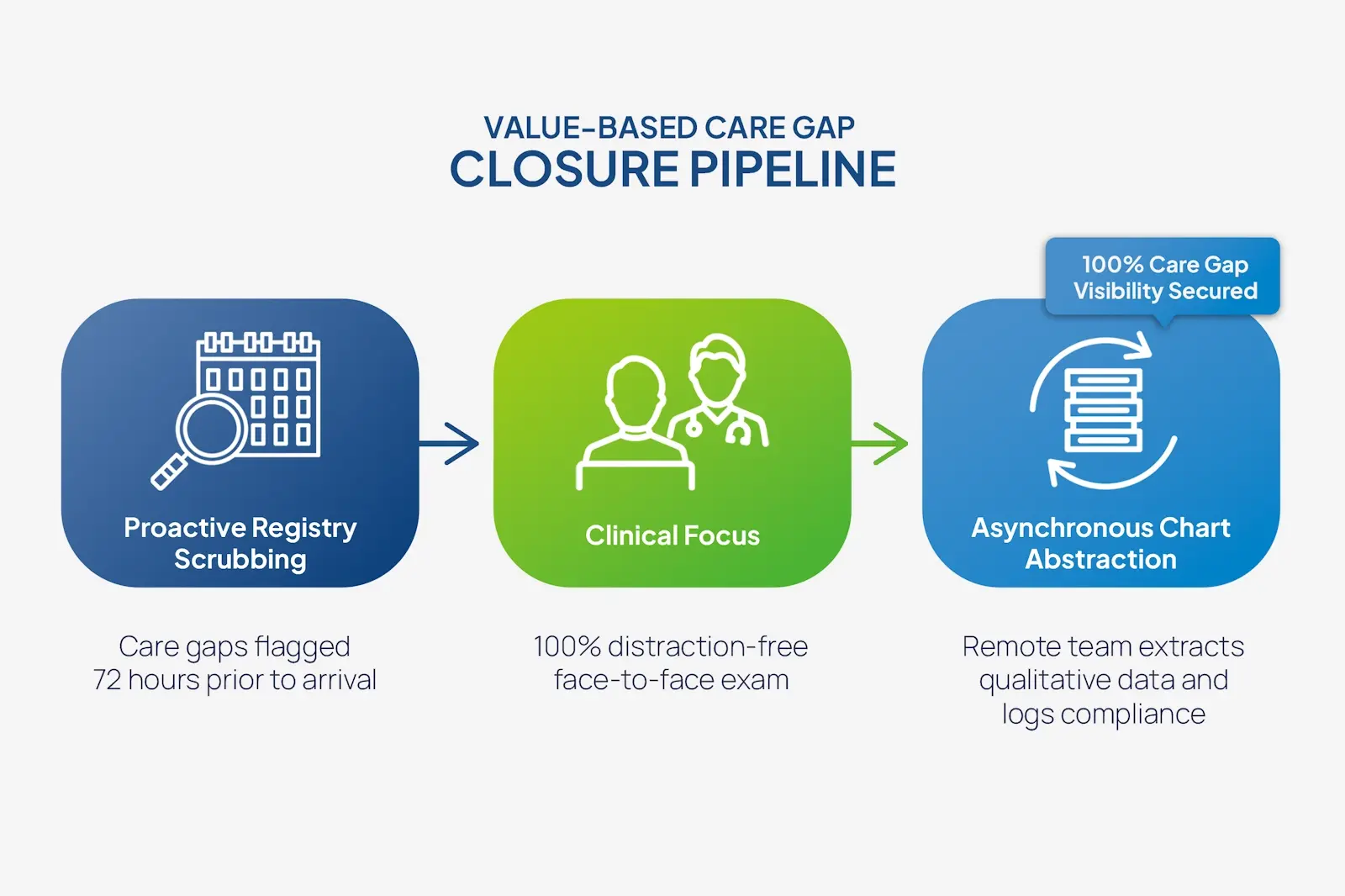
A structured data optimization framework focuses on three core areas:
- Proactive Registry Scrubbing: Instead of forcing a physician to look for missing screenings during a compressed 15-minute exam, dedicated patient access teams scrub the scheduling registry 72 hours in advance. They flag open care gaps and queue up documentation requirements before the patient even enters the building.
- Asynchronous Chart Abstraction: Transitioning the burden of mining unstructured clinical notes, external lab PDFs, and historical specialist consultations to remote, specialized quality-metric navigators. This structural shift frees up on-site staff to focus entirely on physical patient throughput.
- Targeted Care Gap Interventions: Utilizing predictive population registries to identify high-risk, un-attributed patients who are overdue for critical metrics like diabetic retinal scans or blood pressure evaluations, allowing teams to execute proactive outreach workflows.
Operationalizing the VBC Engine: Protecting Clinical Workforce Capacity
Transitioning to value-based care models requires moving past simple technological updates. An EHR system cannot automatically fix care delivery gaps or resolve language barriers on its own; it requires organized execution. When a healthcare organization integrates an optimized backend support infrastructure, on-site personnel are immediately relieved of the “click fatigue” that erodes daily efficiency.
By establishing continuous data cleaning and patient tracking pipelines, administrative leaders create a more sustainable workflow. Care navigators can smoothly handle the manual data collection required by complex contracts. This setup allows physicians to focus entirely on treating patients, while the practice cleanly secures the high quality scores needed to optimize shared-savings payouts, maximize network keepage, and enhance long-term contract performance.
Conclusion: Transforming Quality Metrics from a Burden Into a Competitive Advantage
Thriving in the modern value-based healthcare market requires a fundamental shift in perspective. Quality metrics should not be treated as an administrative tax that drains your team’s energy. Instead, they should be utilized as a strategic asset that validates your clinical excellence and protects your bottom line.
Eliminating reporting friction requires a systematic approach that balances analytical software with disciplined, scalable execution. By leveraging remote chart abstraction and structured population health management, forward-thinking medical practices can protect their clinical teams from burnout, maximize provider utilization, and fully capture the financial rewards of high-value care delivery. To evaluate how your medical group can implement advanced chart abstraction and quality-metric tracking workflows that maximize shared-savings revenue without overloading your staff, contact us today to schedule an operational assessment with our Management Team.