The True Cost of “Follow-the-Sun” Labor
For years, the global outsourcing playbook for healthcare organizations was driven by a single financial metric: the lowest possible hourly rate. Hospital networks, medical groups, and healthcare enterprises routinely directed their revenue cycle management (RCM) and patient support processes to far-flung offshore regions like Southeast or South Asia. The promise was an endless “follow-the-sun” workforce that could process high-volume, low-complexity clerical tasks while domestic clinical staff slept.
However, as healthcare operations become more digitized, integrated, and dependent on immediate turnaround times, this legacy strategy is undergoing an aggressive reassessment. Forward-thinking Chief Operating Officers are discovering that while offshore delivery offers low raw labor costs, it imposes a heavy geographic tax that can ultimately erode the practice’s overall performance. In a high-velocity clinical environment, a 10-to-12-hour time gap creates operational friction that delays issue resolution, complicates compliance, and limits patient continuity.
The Temporal Distance Tax
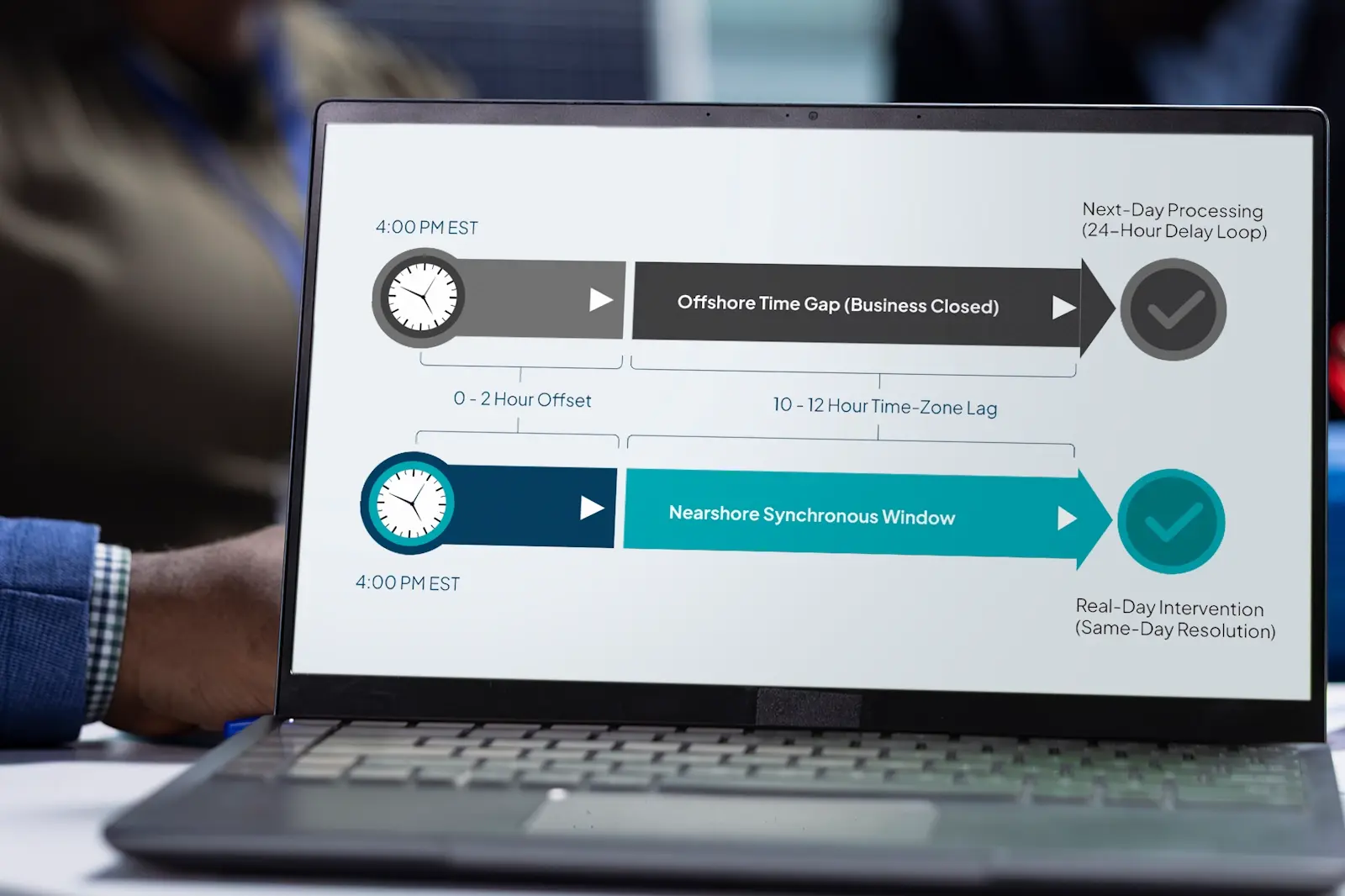
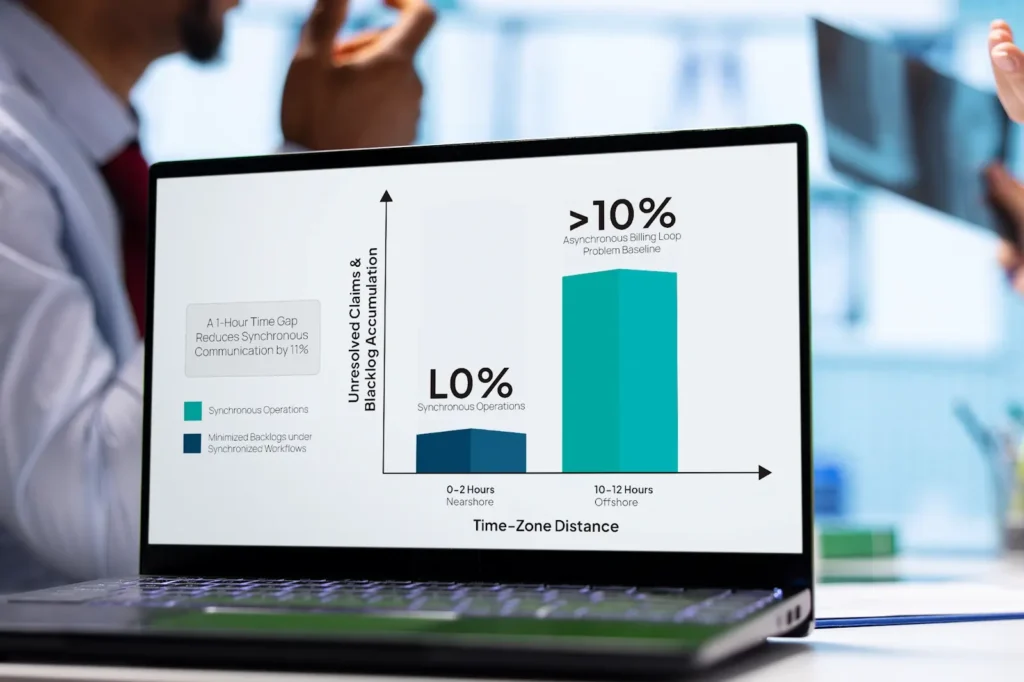
The financial and operational impact of time-zone distance is measurable and significant. Academic research tracking distributed teams shows that a mere one-hour increase in “temporal distance” between employees reduces synchronous communication by 11%. When an outsourcing provider operates entirely outside domestic business hours, the opportunity for real-time problem-solving vanishes. This lack of overlap forces teams into a slow “waiting game,” where a critical billing clearance or a complex care escalation requested at 4:00 PM EST sits completely untouched until the following morning.
In healthcare administration, this lag translates directly into delayed patient access and lost revenue. For example, if an intricate denial or missing documentation requirement surfaces mid-afternoon, an offshore team will not review it until New York business operations have closed for the day. By the time they request clarification, an entire billing cycle is lost, appeal windows compress, and patient scheduling pipelines stall.
Nearshore outsourcing—partnering with specialized teams in neighboring regions that mirror domestic time zones—neutralizes this delay. By operating on a synchronous workflow, nearshore personnel act as a direct, live extension of the provider’s on-site practice.
Nearshore vs. Offshore Operational Dynamics
| Operational Dimension | Offshore BPO Model (e.g., Southeast Asia) | Nearshore BPO Model (e.g., Latin America) | Clinical & Financial Impact |
| Time-Zone Alignment | 10–12 hour offset; opposite schedules. | 0–2 hour offset; complete business-hour overlap. | Nearshore enables live problem-solving and immediate system updates. |
| Denial Response Velocity | Next business day (24-hour feedback loop). | Same-day resolution (real-time intervention). | Minimizes days-in-AR and prevents structural cash flow leaks. |
| Provider Communication | Asynchronous ticketing and recordings. | Synchronous calling, live briefings, and calibration. | Eliminates context switching; keeps workflows aligned. |
| Bilingual Capabilities | High English proficiency; limited Spanish capacity. | High English proficiency; native Spanish capability. | Vital for engaging growing domestic Spanish-speaking patient populations. |
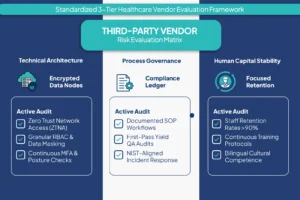
| Compliance Oversight | Structurally difficult to verify across distance. | Real-time auditing and direct governance loops. | Ensures tight alignment with HIPAA, SOC 2, and data safety protocols. |
Real-Time Calibration
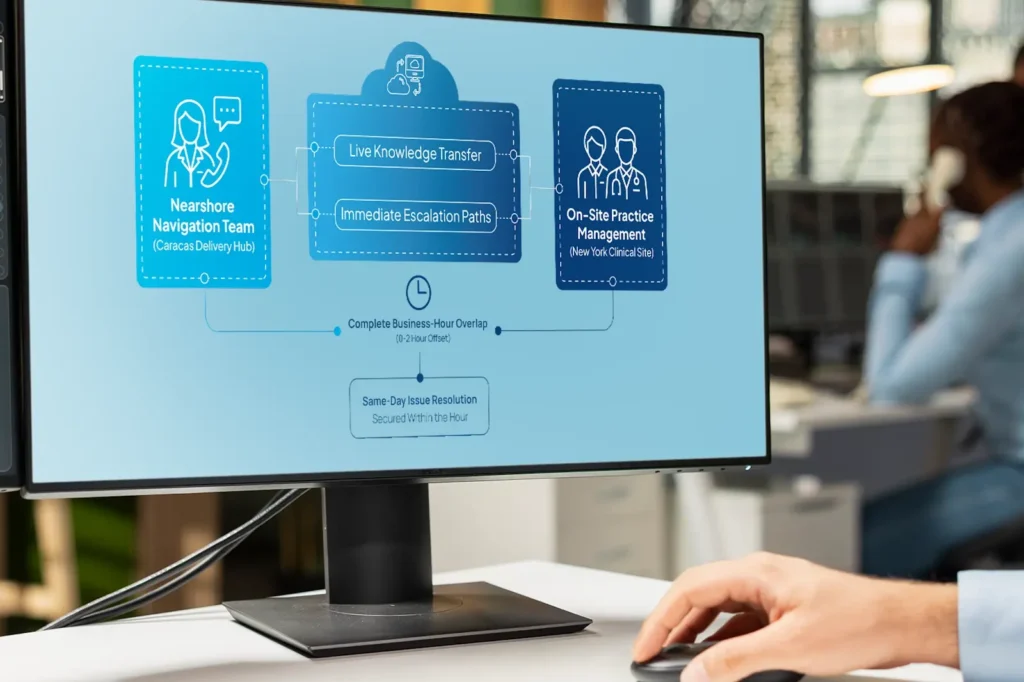
The core advantage of a nearshore model lies in the speed and frequency of its feedback loops. In complex workflows like patient navigation, prior authorization, and advanced claims recovery, operations cannot run effectively in isolation. When an administrative partner shares an identical time zone—such as matching a Caracas delivery center with a New York clinical practice—the relationship shifts from transactional task execution to genuine collaboration.
This real-time alignment delivers concrete advantages across daily operations:
- Immediate Escalation Paths: If a patient care coordinator flags a critical clinical discrepancy or a behavioral health escalation during the day, the partner can immediately consult live with the clinic’s management. The issue is resolved within the hour, rather than sitting in an inbox overnight.
- Live Knowledge Transfer: Policy changes, insurance update mandates, or new digital workflow rollouts can be walked through via live training sessions rather than static recordings. This tight loop prevents the performance drop and “architectural drift” that frequently occurs when distant teams operate in a bubble.
- Seamless Patient Experience: When a patient calls with a complex scheduling or care coordination inquiry, a nearshore team working in the same window can connect directly with domestic clinics to secure a same-day resolution. This rapid loop drives up patient satisfaction and dramatically drops appointment no-show rates.
Shifting the Metric From Cost-Per-Hour to Total Value
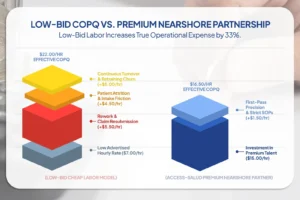
Thriving in a highly competitive healthcare market requires moving past the outdated strategy of optimizing for the lowest raw hourly rate. A lower per-transaction cost means very little if it results in an accumulation of unresolved denials, increased administrative work for your internal team, and gaps in patient outreach.
By realigning your operational support with your actual business hours, you replace disjointed, asynchronous tasks with a responsive, synchronized pipeline. Choosing a nearshore partner with strong time-zone alignment gives healthcare administrators a practical framework to decrease days-in-AR, reduce internal staff burnout, and provide a seamless, high-quality experience for patients.
To evaluate how your medical group can reengineer its patient access and revenue cycle pipelines using a time-zone aligned nearshore framework, contact us today to schedule an operational assessment with our Management Team.