For hospital executives and Directors of Operations, back-office outsourcing is often evaluated through a narrow lens: raw hourly wage rates. On paper, traditional offshore BPO hubs in Southeast Asia offering low hourly rates appear financially unbeatable. However, when deployed in high-velocity healthcare workflows—such as prior authorizations, real-time patient triage, and denials management—healthcare providers encounter a hidden, compounding operational drain: the Temporal Distance Tax.
The Temporal Distance Tax represents the accumulated financial and operational erosion caused by severe time-zone gaps (typically 10 to 13 hours). While offshore vendors promise round-the-clock coverage, the reality for U.S. healthcare operations is often characterized by 24-hour feedback delays, morning-after error corrections, and elevated vendor management overhead.
Quantifying the Temporal Distance Tax in Healthcare Operations
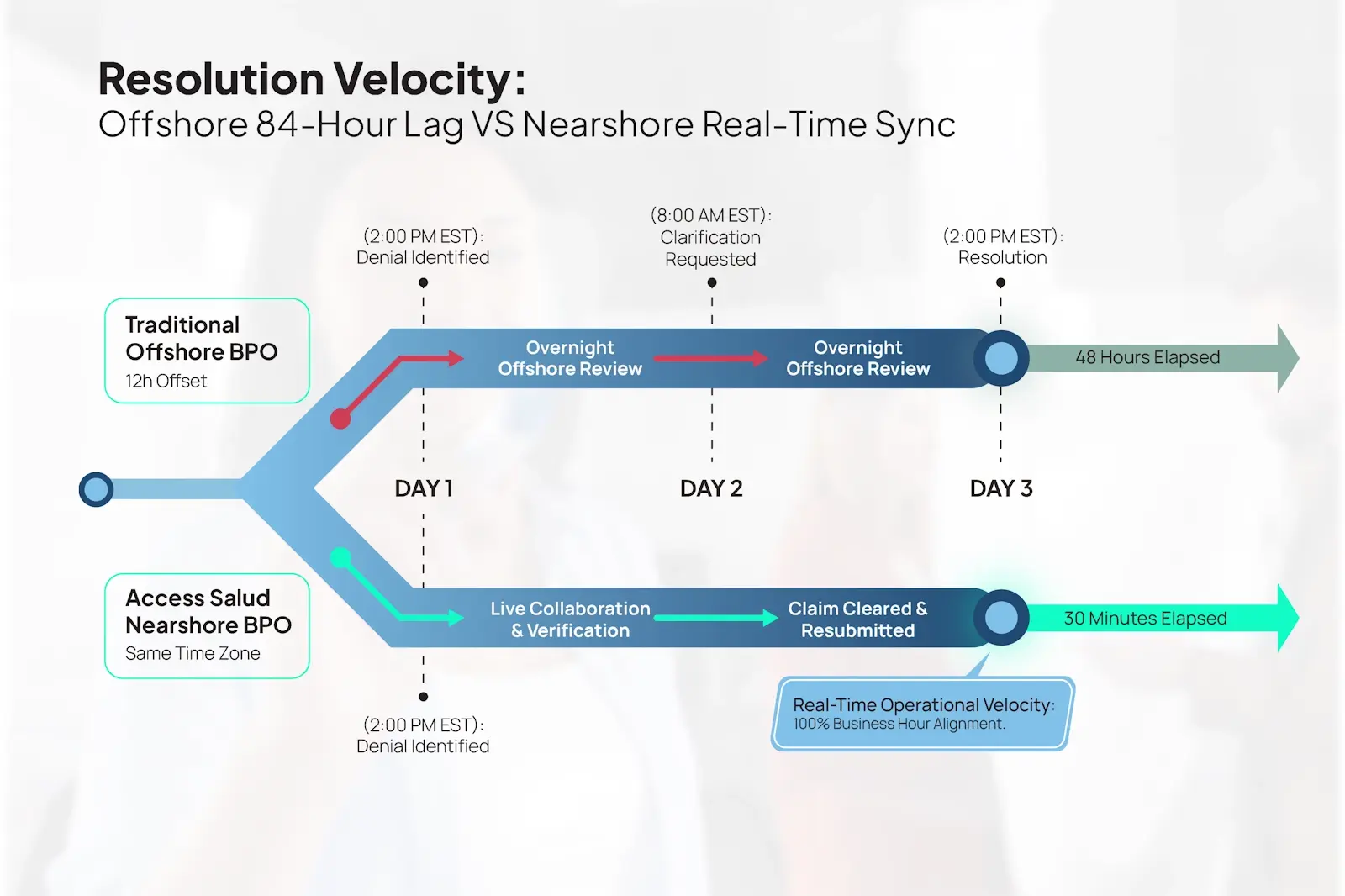
In clinical administrative environments, delays do not simply stall schedules—they directly impact revenue cycles and patient access. When a U.S.-based operations team identifies an urgent claim denial or missing clinical documentation at 2:00 PM EST, a traditional offshore team operating in a 12-hour opposing time zone is offline.
This structural gap creates distinct operational friction points:
- 24-Hour Feedback Loops: A single clarification on a prior authorization request requires an entire day cycle: issue identified on Day 1, reviewed overnight by the offshore team, returned with questions on Day 2, and resolved on Day 3. What should take 20 minutes consumes 48 hours.
- Elevated Management Overhead: U.S. operations managers frequently find themselves forced into early morning or late-night calls, or dedicating significant hours to written documentation, offsetting initial labor savings through executive fatigue and administrative overhead.
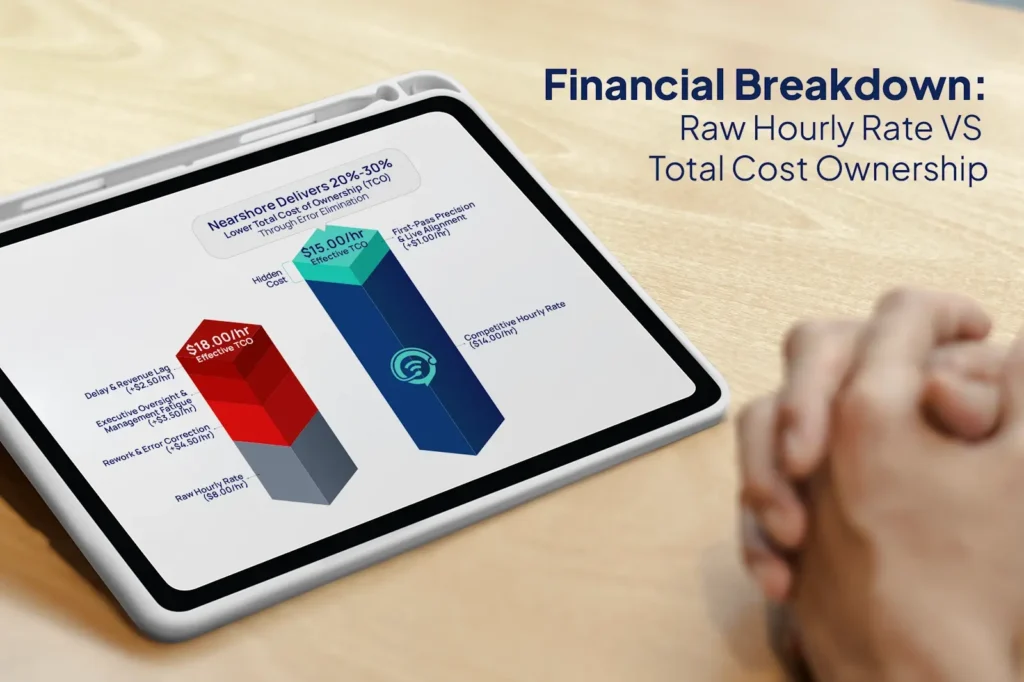
- Quality Rework & Claims Lag: According to industry analysis on nearshore vs offshore BPO cost dynamics, while offshore hourly rates range from $6 to $14/hr, high attrition rates and communication friction frequently drive up rework. Conversely, nearshore models ($12 to $18/hr) provide same-time-zone overlap, reducing total cost of ownership (TCO) through immediate resolution.
The Nearshore Advantage: Same-Time-Zone Operational Momentum
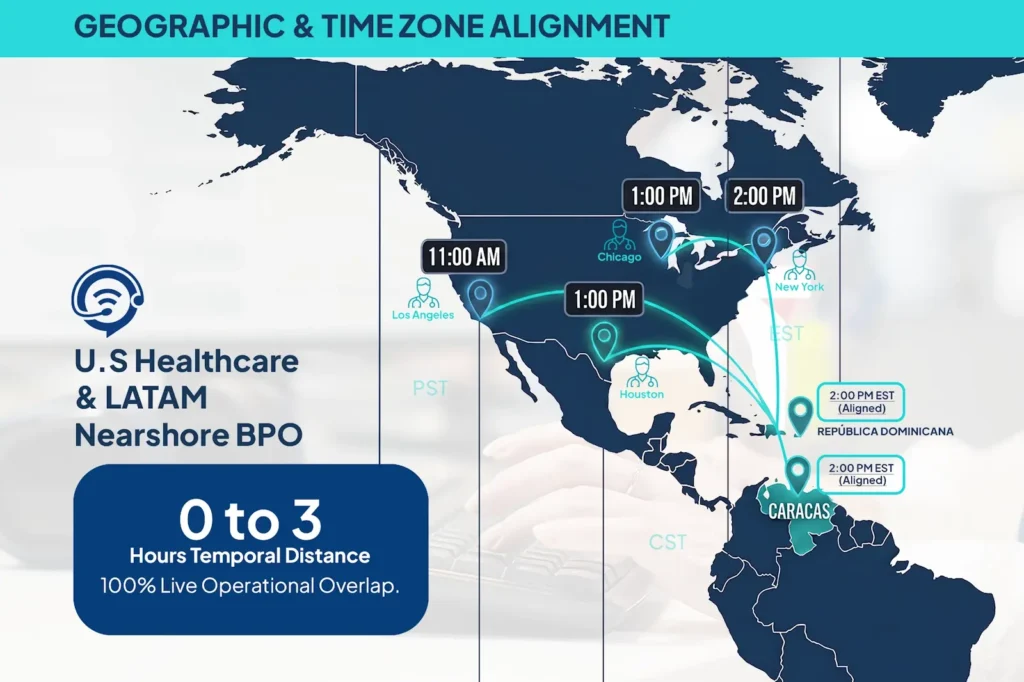
To eliminate the Temporal Distance Tax, leading healthcare networks are transitioning to Nearshore Healthcare BPO Architecture in Latin America. Operating within 0 to 3 hours of U.S. time zones (EST/CST/PST), nearshore operational teams work side-by-side with U.S. clinical and practice personnel during active office hours.
As highlighted in the Vinali Group 2026 LATAM Outsourcing Report, time-zone alignment transforms third-party support from an isolated handoff into real-time collaboration:
- Immediate Denial & Triage Resolution: Care coordinators and RCM specialists resolve claim rejections and patient intake roadblocks live during business hours, preventing operational backlogs.
- Cultural & Regulatory Synchronization: Nearshore teams in LATAM demonstrate high cultural affinity with U.S. healthcare practices, shortening onboarding cycles to 4–8 weeks compared to multi-month offshore ramp-ups as detailed in Vinali Group’s Nearshore Advantages Analysis.
- 40%–60% Sustainable Cost Savings: Nearshoring delivers substantial labor savings compared to U.S. domestic staffing while protecting operational velocity and compliance integrity.
Maximizing Operational ROI
For healthcare leadership, true ROI is measured by total process velocity, clean claims rates, and administrative reliability. By erasing the Temporal Distance Tax through nearshore time-zone alignment, medical groups achieve seamless back-office integration, eliminate communication lag, and protect operational quality.
To evaluate how Access-Salud’s nearshore model erases the Temporal Distance Tax and accelerates your operational velocity, contact us today to schedule a strategic ROI assessment with our leadership team.