
The Hidden Tax of Sedentary Workstations
In high-performing corporate environments, operational output is deeply tied to the physical stamina of the workforce. While executives frequently focus on digital infrastructure and optimization strategies, a critical asset often degrades in silence: the musculoskeletal health of office-bound personnel. Sitting at a desk for eight to ten hours a day introduces a heavy, cumulative mechanical load on the human body.
When employees default to poor biomechanical habits, the results manifest as micro-injuries, chronic strain, and cognitive fatigue. According to data published by the Centers for Disease Control and Prevention (CDC) NIOSH Ergonomics Program, work-related musculoskeletal disorders (WMSDs) are among the leading causes of lost or restricted work time across professional industries. For leadership, addressing posture is a proactive mechanism to safeguard human capital, optimize daily processing speeds, and reduce the hidden costs of operational friction.
The Biomechanics of a Neutral Posture
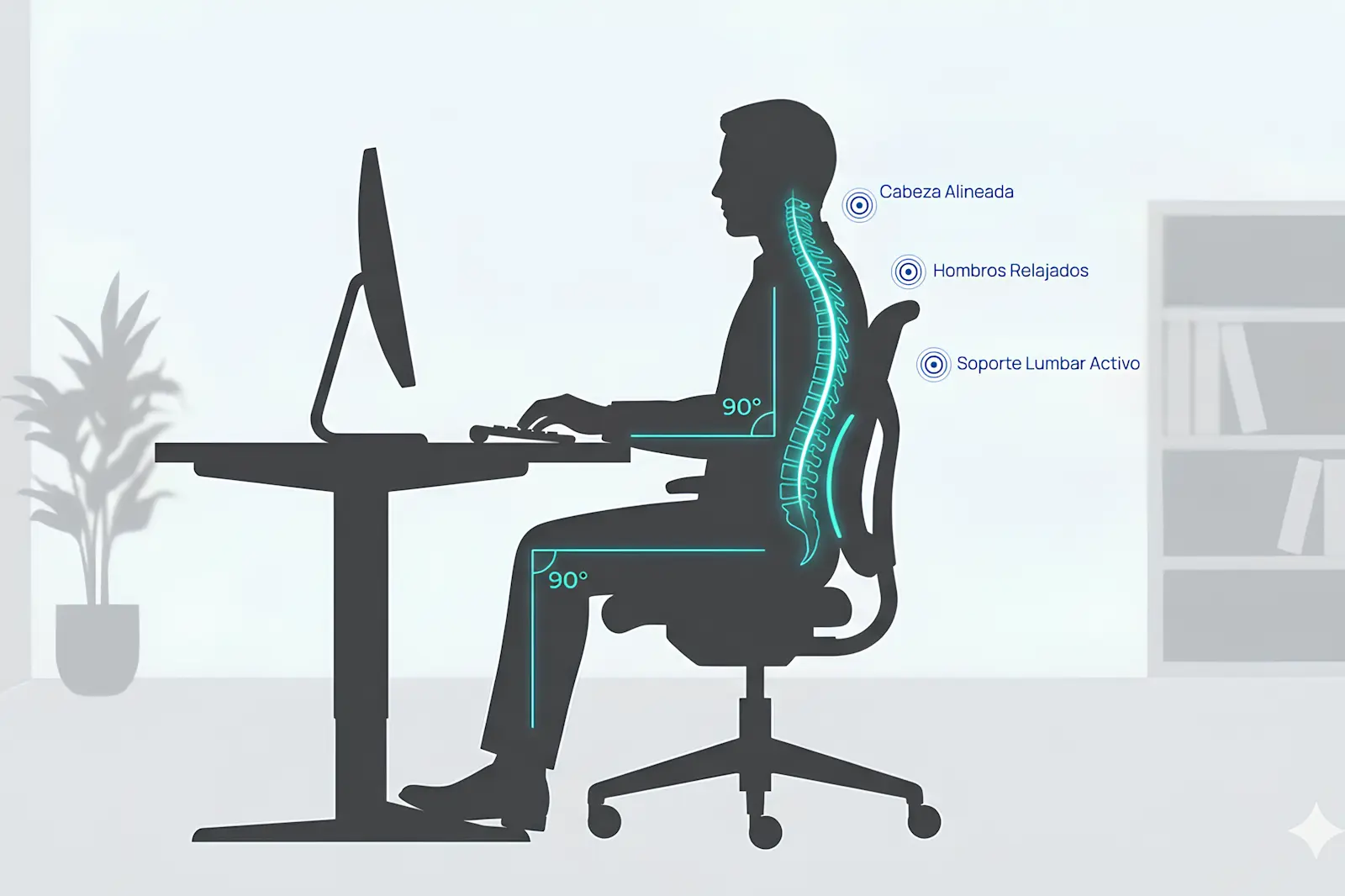
To eliminate the physical exhaustion associated with desk work, professionals must understand the concept of “neutral body positioning.” The human spine is naturally engineered to distribute weight across three distinct curves: cervical (neck), thoracic (mid-back), and lumbar (lower back). Slouching or leaning forward flattens these natural curves, forcing surrounding muscles and ligaments to work overtime just to keep the body upright.
As detailed in the official OSHA Computer Workstations Ergonomics Guide, maintaining a neutral posture minimizes static muscle loading and maximizes mechanical efficiency. Achieving this high-level alignment requires a conscious baseline configuration: keeping the head level and inline with the torso, relaxing the shoulders to let upper arms hang naturally, and positioning the lower back flat against a supportive lumbar rest. When the skeletal framework bears the body’s weight correctly, muscular strain drops sharply, directly preserving an individual’s energy reserves for technical tasks.
[The Slumped Posture Loop]
Forward Head Tilt ──> Kyphosis (Hunched Back) ──> Posterior Pelvic Tilt ──> Chronic Lumbar Pain
[The Neutral Spine Alignment]
Balanced Cranium ──> Retracted Scapulae ──> Supported Lumbar Curve ──> Optimal Kinetic Flow
The Desk-Bound Kinetic Reset: A Step-by-Step Guide
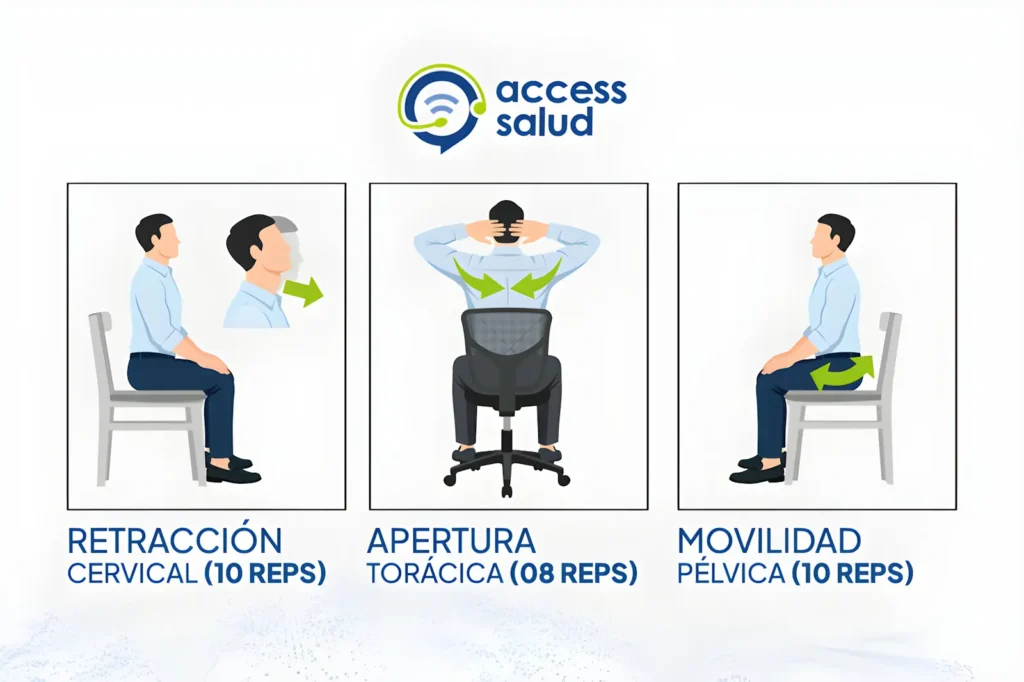
Even with an optimized ergonomic chair, maintaining a single static position for hours restricts circulation and causes tissue stiffness. To break this cycle, professionals should implement low-profile, seated kinetic resets throughout the day. These three precise, data-backed exercises can be performed directly from an office chair without disrupting workflow focus:
- 1. Cervical Retraction (The Chin Tuck):
- Target: Alleviates suboccipital compression caused by craning toward a monitor.
- Execution: Sit completely upright with your back fully supported. Look straight ahead and slowly pull your head straight back, as if making a “double chin” (do not tilt your head down; keep your gaze level). Hold the retraction for 5 seconds, then release. Repeat for 10 repetitions to decompress the upper cervical spine.
- 2. Seated Thoracic Extension & Scapular Squeezes:
- Target: Reverses the forward rounding of the shoulders and chest tightness.
- Execution: Interlace your fingers behind your head or place your hands flat on your lower back. Inhale deeply, pull your elbows back, and gently squeeze your shoulder blades (scapulae) together while lifting your chest toward the ceiling. Hold for 3 to 5 seconds, exhale, and return to center. Execute 8 smooth repetitions to reactivate upper back stabilizers.
- 3. Seated Pelvic Tilts:
- Target: Releases compressed lumbar vertebrae and mobilizes the hip complex.
- Execution: Sit slightly forward on your seat pan with your feet flat on the floor. Place your hands on your hips. Slowly tilt your pelvis forward, arching your lower back slightly, then reverse the motion by tilting your pelvis backward, tucking your tailbone under, and gently rounding your lower spine. Perform this rocking motion smoothly for 10 repetitions to stimulate synovial fluid flow in the lower back.
Engineering Postural Habit Loops into the Daily Routine
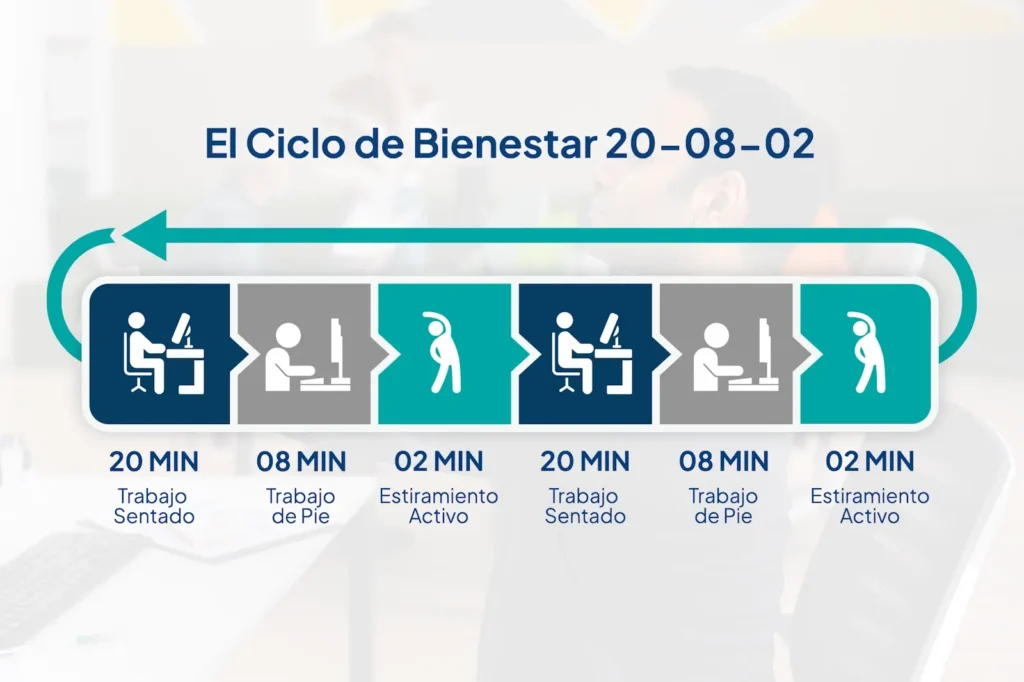
Systematically improving workforce posture requires more than just distributing written information; it demands building a physical environment that prompts positive habits. For example, implementing the “20-8-2 rule”—which recommends sitting for 20 minutes, standing for 8, and moving or stretching for 2 minutes—functions as an excellent operational cadence to maintain metabolic velocity.
Organizations can seamlessly support this transition by integrating subtle, clinical-chic visual cues into the workspace. Utilizing strategically designed desktop screensavers that prompt timed resets, or providing compact, step-by-step pocket guides can turn proper ergonomics from an active effort into an automated routine. By treating mechanical health as a baseline requirement for high-level execution, operations look past simple workplace comfort and build a structural shield against professional exhaustion.
Conclusion: Postural Precision as an Asset Standard
Excellence in leadership and execution begins with the systematic preservation of your team’s physical baseline. Transitioning away from harmful sedentary habits and adopting an intentional, neutral posture directly insulates professionals from the chronic, silent drain of musculoskeletal strain.
When your organization actively builds workflows that honor the natural biomechanics of your personnel, you eliminate an invisible bottleneck to focus, creativity, and daily output.