The Hype Gap: Generative AI vs. Back-Office Bottlenecks
Healthcare executives are flooded with promises of artificial intelligence completely automating clinical and administrative operations. However, CIOs, CTOs, and Directors of Operations recognize a stark divide between media hype and operational reality. Fully autonomous AI agents frequently hallucinate, fail under unformatted medical documentation, and create unacceptable compliance vulnerabilities if left unmonitored.
The true value of AI in healthcare administration lies not in replacing human workforce, but in empowering trained specialists with pragmatic machine learning tools. By deploying targeted automation for repetitive, rule-based tasks—such as optical character recognition (OCR) for intake records, intelligent prior authorization routing, and automated eligibility parsing—health systems significantly accelerate service level agreements (SLAs) while eliminating administrative friction.
The Human-in-the-Loop (HITL) Architecture
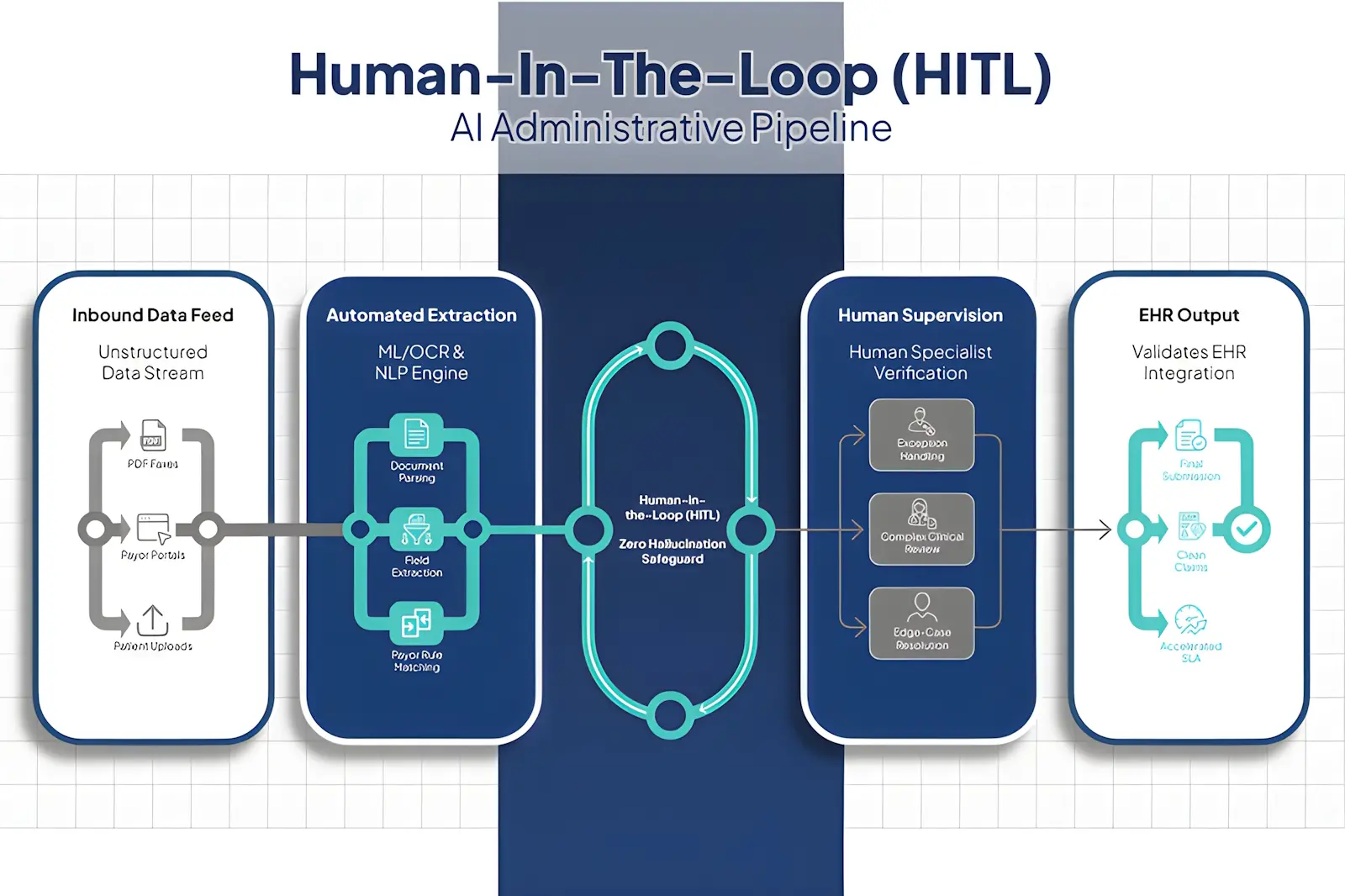
To achieve operational velocity without increasing error rates, forward-thinking medical practices implement a Human-in-the-Loop (HITL) architecture. Under this model, machine learning algorithms execute rapid data ingestion and preliminary document classification, while human specialists manage exception handling, complex clinical reviews, and final data validation.
Applying machine learning to administrative workflows yields immediate operational gains:
- Accelerated Prior Authorizations: AI models extract clinical notes and match them against payor rules in seconds, allowing specialists to submit completed authorization packets within hours instead of days.
- Intelligent Document Indexing: Natural Language Processing (NLP) parses unstructured faxed records, lab results, and referral PDFs, instantly populating EHR fields with high precision.
- Streamlined Patient Navigation: Deploying automated data extraction in patient navigation enables intake teams to verify pre-visit documentation before the patient ever arrives at the clinic.
Data Governance & HIPAA Compliance in AI Workflows
For healthcare IT leaders, security remains the non-negotiable prerequisite for technology adoption. Processing electronic Protected Health Information (ePHI) through third-party public AI models creates immense regulatory risk under HIPAA.
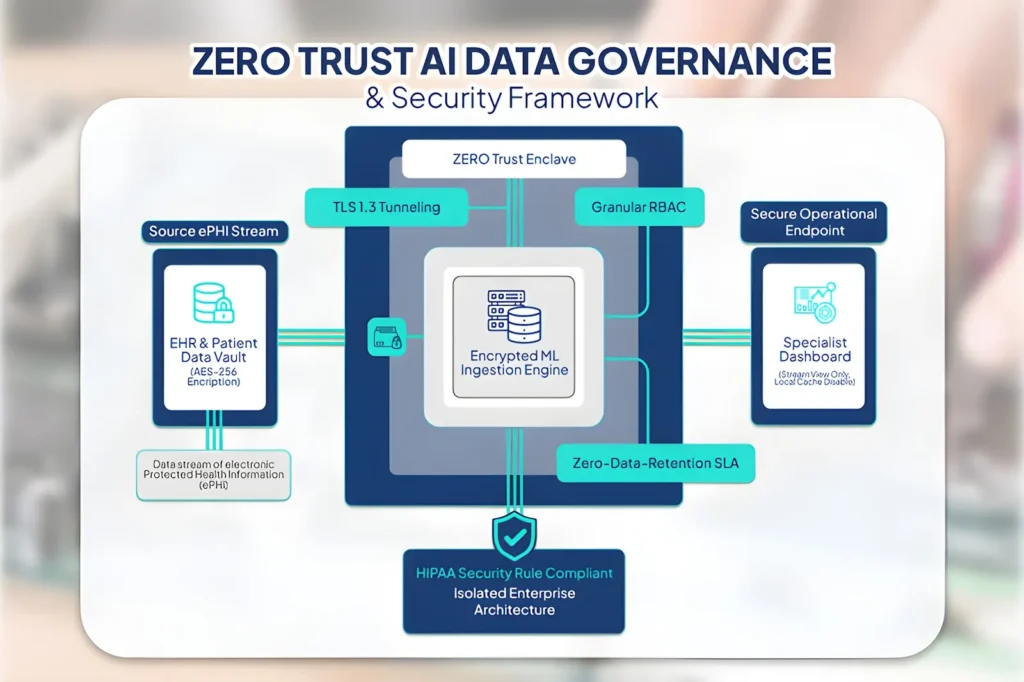
To deploy AI safely, medical groups must enforce enterprise-grade data isolation. Machine learning pipelines must operate within encrypted, closed environments featuring Zero Trust Network Access (ZTNA), strict role-based access controls (RBAC), and zero-data-retention agreements with AI vendors. Ensuring strict data governance allows health systems to automate administrative routines while maintaining HIPAA safeguards across automated workflows.
Unifying Operational Velocity and Front-Office Growth
Back-office administrative speed directly dictates front-office marketing performance. As clinics adopt modern Generative Engine Optimization strategies for patient growth, they generate an influx of high-intent digital inquiries. If the back-office takes 48 hours to process prior authorizations or verify insurance, those prospective patients abandon the booking funnel.
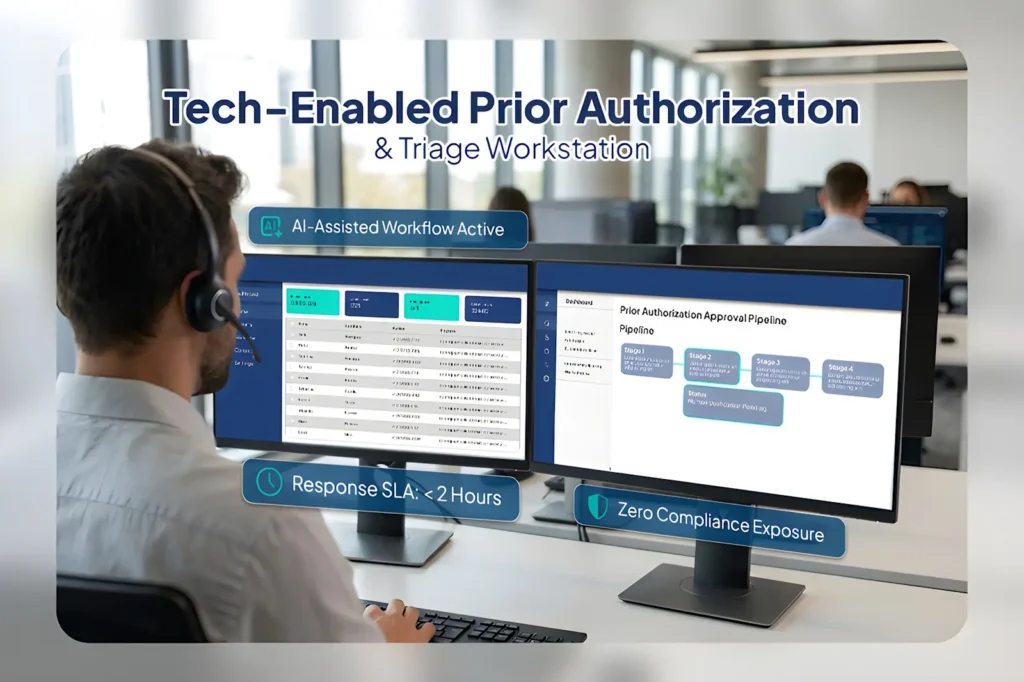
Combining secure automation with dedicated operational teams creates a resilient administrative backbone. Utilizing tech-enabled healthcare back-office solutions arms skilled nearshore specialists with secure, AI-assisted workflows—delivering faster response times, reduced claim denial rates, and predictable operational costs.
Grounding Innovation in Execution
AI is neither a panacea nor a distant novelty; it is a current operational multiplier when paired with rigorous human oversight. Healthcare organizations that cut through the noise and deploy secure, HITL automation today will establish unmatched operational resilience. To learn how our tech-enabled operational support can streamline your administrative workflows, connect with us today.