

For years, “cultural competence” was treated as a checkbox in the HR manual—a moral obligation to be inclusive. But in 2026, the data has caught up with the mission. Under the latest Joint Commission National Patient Safety Goals and the HTI-1 data transparency mandates, linguistic access has evolved. It is no longer just a “nice to have”; it is a clinical requirement with a direct impact on the bottom line.
The Cost of Silence
The financial stakes of language barriers are higher than ever. Recent studies show that patients with limited English proficiency (LEP) face a 34% longer hospital stay and double the risk of medical errors compared to English-proficient patients. In an era where medical inflation is nearing 9%, these inefficiencies are “margin killers.”
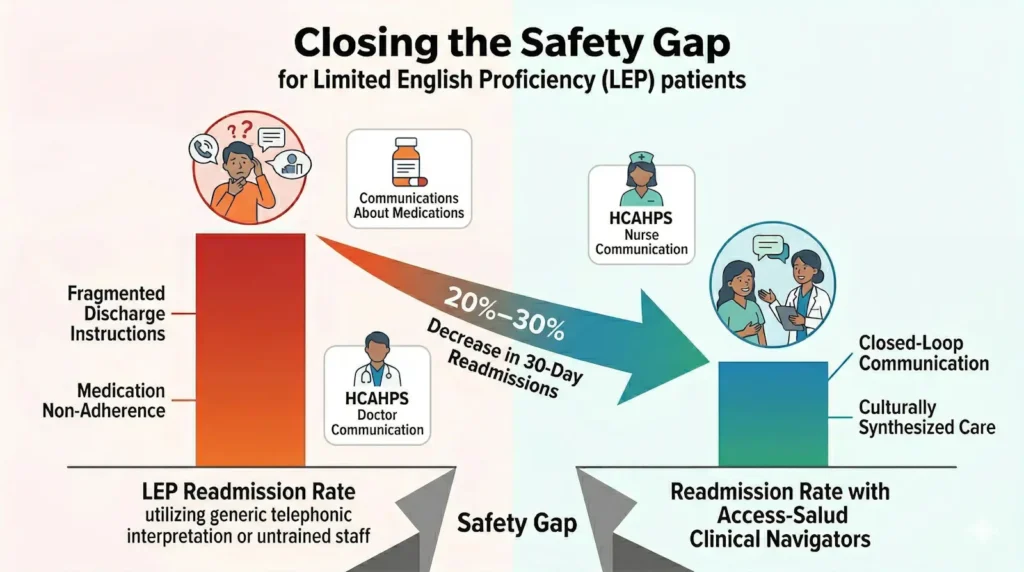
When a patient doesn’t fully understand their discharge instructions or medication dosing, the result is predictable: Avoidable Readmissions.
Linguistic ROI: The Numbers Behind the Nuance
At Access-Salud, we view our bilingual navigators as the “Human Engine” of the healthcare system. By integrating professional linguistic support into the clinical workflow, organizations see a measurable Linguistic ROI:
- Reduced 30-Day Readmissions: Consistent access to professional navigators has been shown to drop readmission rates for LEP patients significantly, saving hospitals an average of $160,000+ per month in avoided penalties and care costs.
- Boosting HCAHPS Scores: Patient satisfaction is rooted in being heard. When a patient can communicate in their native tongue, “Communication with Nurses” and “Care Transition” scores—key drivers of value-based reimbursement—see a direct uplift.
- Risk Mitigation: In 2026, “Information Blocking” isn’t just about technology; it’s about accessibility. Providing human-in-the-loop navigation ensures you meet Section 1557 of the ACA requirements, protecting your organization from $1M+ non-compliance fines.
Moving Beyond Translation
Translation is a commodity; Navigation is a strategy. A translator converts words, but an Access-Salud Clinical Navigator converts intent. Our team doesn’t just speak the language; they understand the cultural barriers that prevent a patient from following a treatment plan—whether it’s a mistrust of the system or a lack of health literacy.
By offloading this complex “human layer” to Access-Salud, your internal staff can focus on the clinical tasks they were trained for, reducing burnout and ensuring that equity isn’t just a goal—it’s an operational reality.
Is your practice capturing its Linguistic ROI? Schedule a Consultation with Access-Salud to optimize your patient navigation today.