
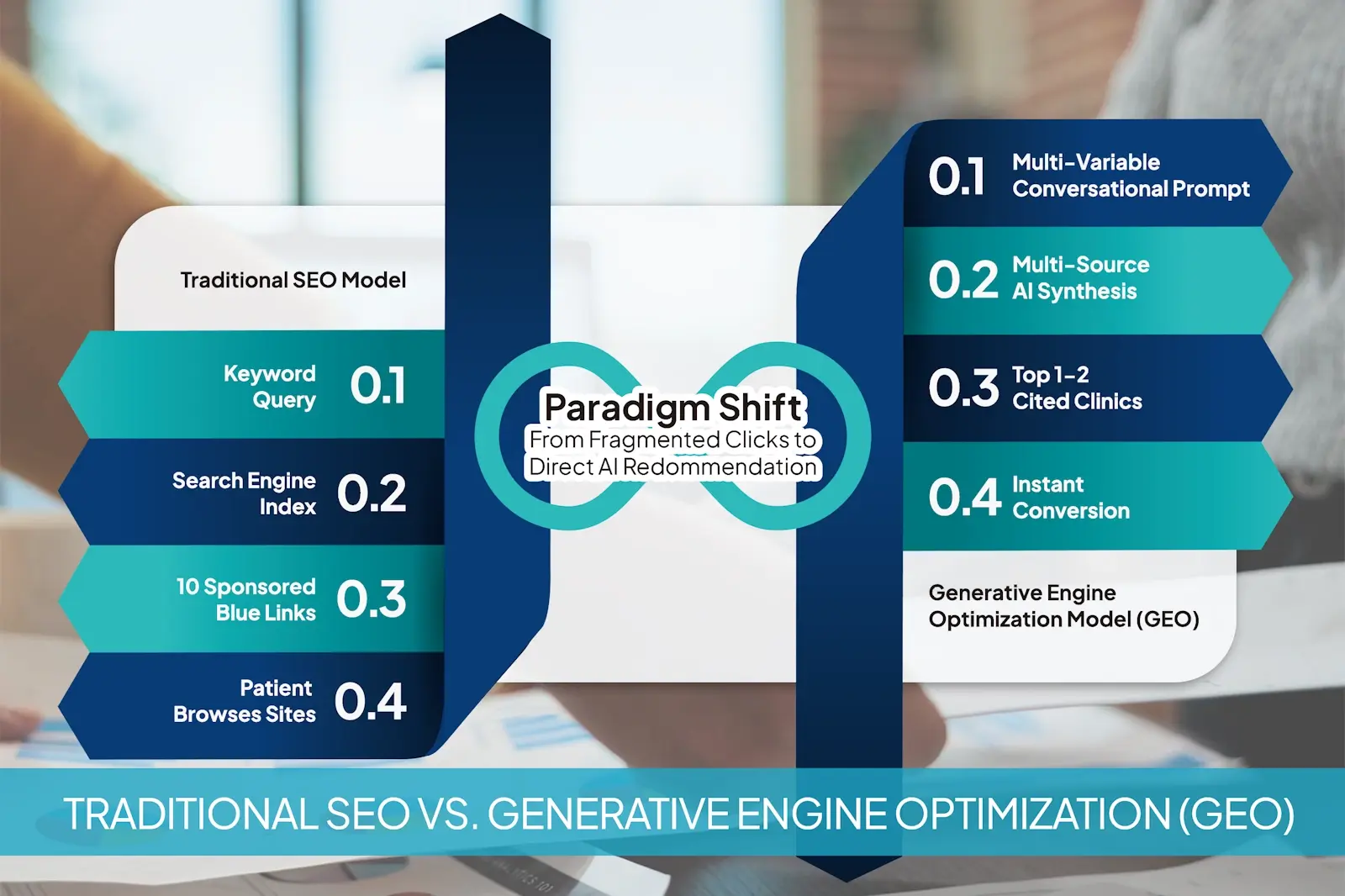
The Paradigm Shift: From Keywords to AI Recommendations
For two decades, digital patient acquisition meant optimizing clinic websites for search algorithms and bidding on keywords to win Google’s top blue links. Today, patient discovery behavior is undergoing a profound transformation. Healthcare consumers are increasingly bypassing traditional search bars in favor of generative AI engines like ChatGPT, Perplexity, and Google Gemini.
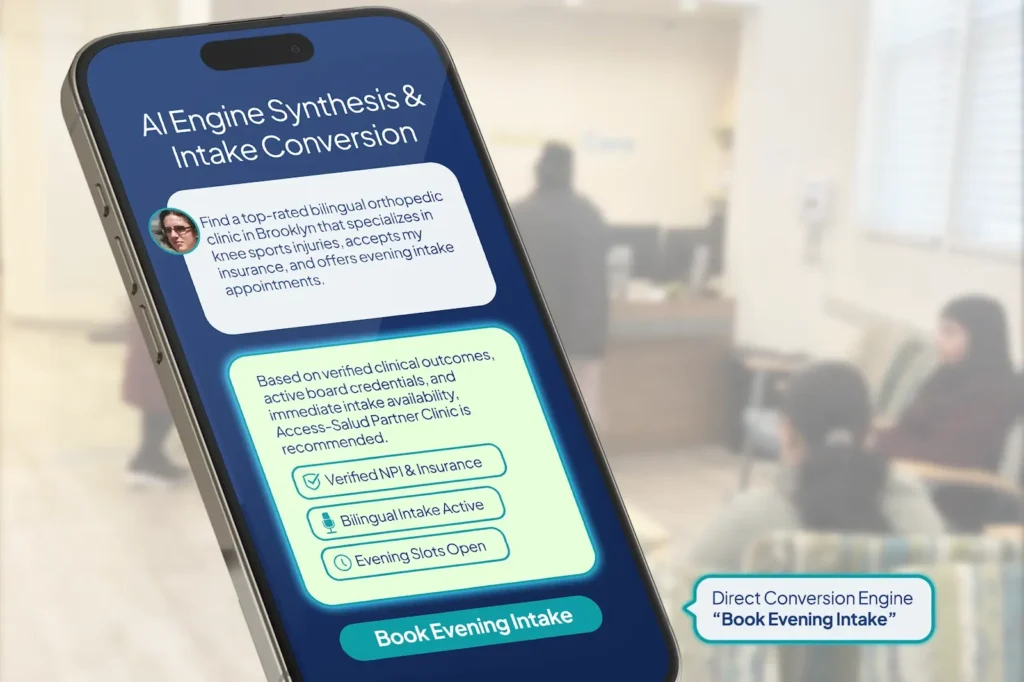
When a prospective patient seeks care today, they rarely type fragment queries like “orthopedic surgeon near me.” Instead, they prompt AI engines with complex, multi-variable questions: “Find a top-rated bilingual orthopedic clinic in Brooklyn that specializes in knee sports injuries, accepts my insurance, and offers evening intake appointments.”
Generative engines do not return a list of sponsored links to browse; they synthesize web-wide data to confidently recommend one or two specific medical practices. Medical groups that fail to adapt to this algorithmic transition risk becoming invisible to a rapidly growing segment of digital-native patients.
Decoding GEO: The Rules of AI Visibility
Generative Engine Optimization (GEO) is the strategic discipline of optimizing your digital presence so that artificial intelligence models reliably cite, trust, and recommend your clinic.
First formally defined by researchers from Princeton University and Georgia Tech, GEO establishes that the rules of digital visibility have fundamentally changed. To understand GEO, you must look at how it differs from traditional Search Engine Optimization (SEO):
- The Goal: SEO competes for numerical positions on a search page to drive clicks. GEO competes to be the direct, trusted answer synthesized inside the AI’s response.
- The Focus: SEO focuses on keyword density and backlinks. GEO focuses on verifiable facts—training AI models to recognize a brand’s clinical specialties, locations, and operational attributes with absolute confidence across multiple platforms.
To win recommendations in AI search results, medical practices must align their digital presence across three primary pillars:
- Authoritative Clinical Answers: Generative models ignore vague marketing claims. They favor content containing explicit statistics, verifiable clinical outcomes, and direct quotes from credentialed specialists.
- Verified Directory Consensus: AI engines verify a clinic’s legitimacy by cross-referencing profiles across NPI registries, state medical boards, healthcare directories, and patient reviews. Consistency across the web is mandatory.
- Clear Operational Data: AI crawlers must be able to seamlessly read your accepted insurance plans, bilingual capabilities, and real-time intake hours without ambiguity.
Fewer Leads, Higher Intent: The Back-Office Bottleneck
As medical growth strategists note, AI search fundamentally alters lead dynamics: clinics receive fewer total inquiries, but dramatically higher-intent leads.
When an AI engine tells a patient that your clinic matches their exact clinical, linguistic, and insurance criteria, that patient reaches out fully pre-informed and ready to schedule. However, this high intent creates an immediate operational vulnerability.
If an AI-recommended lead encounters a busy phone line, a clunky multi-day contact form, or an agent incapable of verifying insurance eligibility on the spot, the patient immediately returns to the AI engine for an alternative recommendation. Capturing this new wave of demand requires robust backend infrastructure capable of converting high-intent patient inquiries with bilingual triage
High visibility on the front end is worthless if the back office lacks the operational velocity to close the loop.
Operational Readiness: Scaling Your Digital Front Door
Adapting to the AI search era requires unifying modern healthcare marketing with back-office execution. Forward-thinking practice administrators recognize that scaling patient acquisition involves moving beyond basic marketing tools toward practical AI integration in healthcare back-offices [[Internal Link: September Post]].
To ensure no high-value lead falls through the cracks, clinics must deploy rapid-response digital front door solutions that handle multi-channel inbound messaging, verify insurance eligibility in real time, and schedule appointments. Combining advanced front-end GEO visibility with dedicated nearshore operational bandwidth ensures that every digital recommendation translates into a scheduled patient consultation.

Dominating Patient Discovery
Generative Engine Optimization is not a distant trend; it is the current frontier of digital healthcare growth. Medical practices that restructure their authoritative footprint for AI synthesis today—and back it up with rapid intake operations—will capture dominant market share. To explore how our integrated intake infrastructure can help your practice convert high-intent digital demand into long-term patient volume, connect with our growth team today.
To explore how our integrated intake infrastructure can help your practice convert high-intent digital demand into long-term patient volume, connect with our growth team today.