The Illusion of the Lowest Bidder
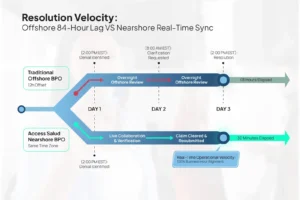
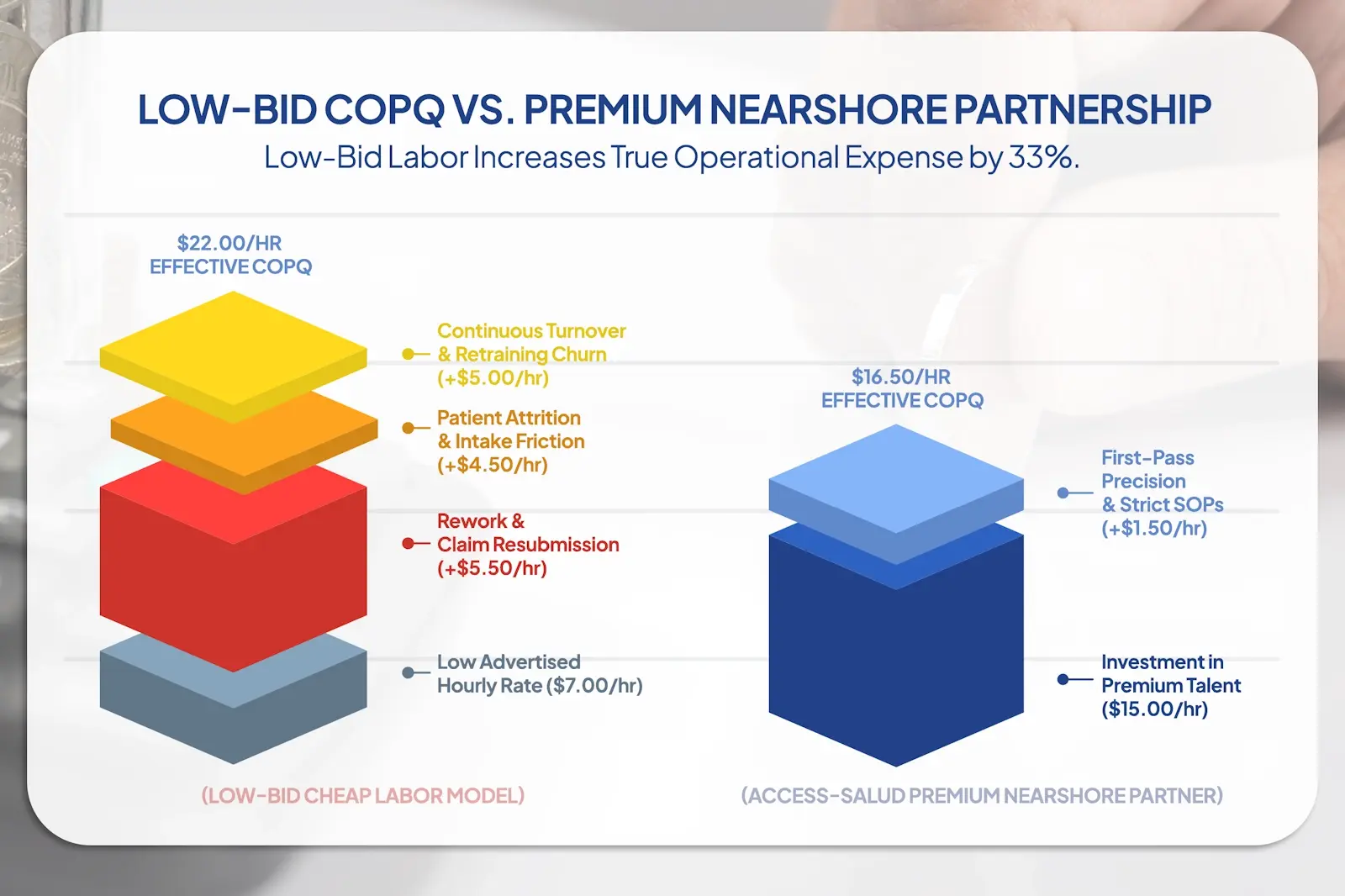
In the high-pressure economic environment of modern healthcare, administrators and executives are aggressively seeking ways to reduce overhead and protect compressing margins. When evaluating Business Process Outsourcing (BPO) partners, the initial instinct is often to select the vendor offering the lowest hourly rate. However, macroeconomic realities demonstrate that in complex medical operations, “cheap” labor frequently carries hidden, exponential costs.
Relying strictly on the lowest bidder ignores the massive administrative overhead required to monitor, correct, and manage poor-performing vendors. When healthcare groups partner with low-cost operators, the resulting high error rates and constant staff turnover erode the very margins executives are trying to protect, turning a perceived cost-saving measure into an operational liability.
The Cost of Poor Quality (COPQ) and Patient Acquisition
In healthcare administration, operational errors are not mere inconveniences; they are direct hits to the revenue cycle and patient pipeline. The American Society for Quality (ASQ) defines the Cost of Poor Quality (COPQ) as the costs associated with providing poor-quality products or services, which can drain a massive percentage of overall revenue through systemic rework and lost opportunities.
When applied to medical outsourcing, a single mishandled patient intake, a delayed bilingual triage, or an incorrectly processed insurance verification doesn’t just delay reimbursement—it causes patient attrition. When front-line administrative staff lack necessary cultural competence and rigorous standard operating procedures, patient trust diminishes. This directly sabotages strategic growth and patient acquisition initiatives. Offloading these critical touchpoints requires specialized backend support services.
The Service-Profit Chain: Strategic Outsourcing as a Growth Lever
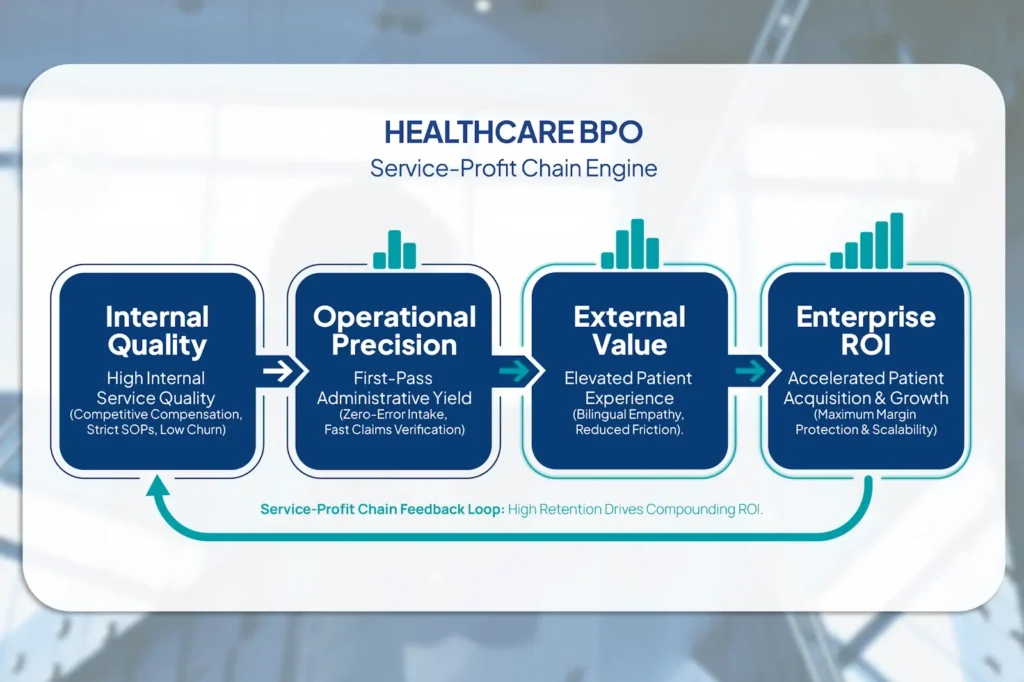
Rather than viewing outsourcing strictly as a cost-cutting measure, forward-thinking medical organizations treat it as a strategic investment in operational capacity. This aligns with the foundational Service-Profit Chain business model, which proves that high internal service quality and employee retention directly drive external customer (or patient) value, ultimately accelerating acquisition and revenue growth.
By prioritizing highly trained, nearshore talent, clinics ensure that patient interactions are handled with empathy and accuracy. This elevated standard of service transforms administrative support from a cost center into a reliable patient acquisition engine. High-quality backend operations allow in-house clinical teams to scale seamlessly without compromising the patient journey.
The Long-Term Economic Advantage of Talent Retention
BPO vendors competing solely on price inevitably suffer from massive employee turnover. This constant churn means medical groups are perpetually subsidizing the learning curve of new, inexperienced agents. The financial burden of replacing an employee is widely recognized by core human resources benchmarks to cost anywhere from one-half to two times the employee’s annual salary. A metric that devastates ROI when applied to a high-churn BPO partner.
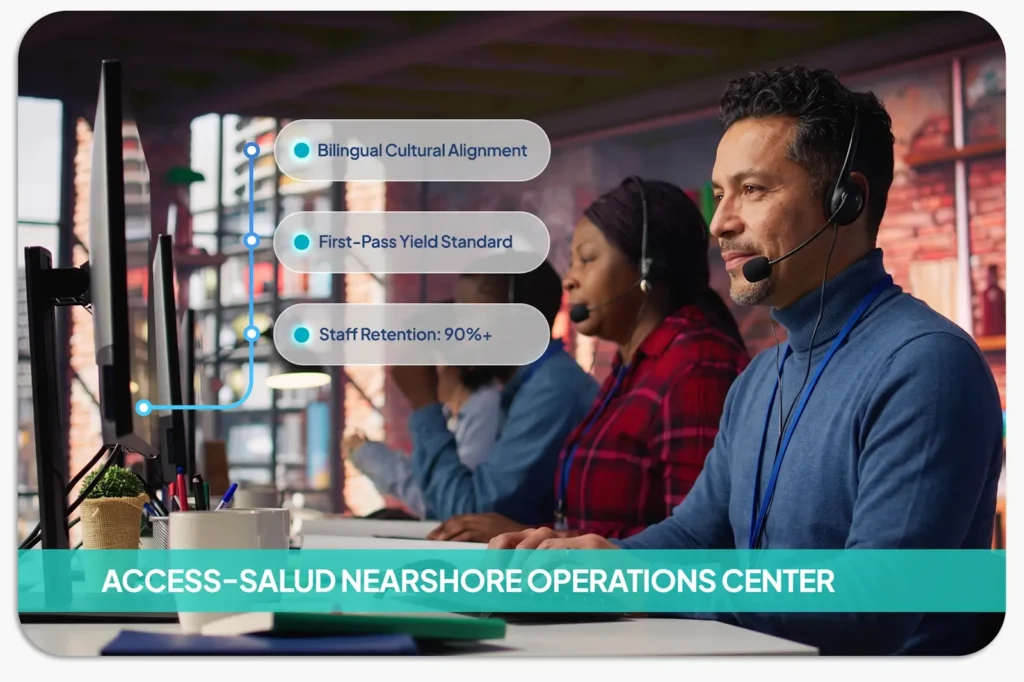
Conversely, premium outsourcing partners invest in their workforce through competitive compensation, strict task-tracking SOPs, and holistic professional development. This investment fosters the high retention rates that are central to the Access-Salud workplace culture. Retaining top talent ensures that institutional knowledge stays within the organization, operational efficiency compounds over time, and the partnership delivers true long-term macroeconomic stability.
Conclusion: Shifting the Paradigm from Cost to Value
The macroeconomics of modern healthcare demand a shift from seeking the cheapest labor to securing the highest sustainable value. Quality outsourcing protects the revenue cycle, enhances the patient journey, and ensures predictable organizational growth. To see how our highly specialized nearshore teams can seamlessly integrate into your workflows and drive targeted patient acquisition, explore our comprehensive operational insights on the Access-Salud Operations Blog .