

In 2026, the clinical landscape is defined by a new acronym with high-stakes consequences: USCDI v3. Under the HTI-1 Final Rule, the “grace period” for health data standards has officially expired. As of this year, the United States Core Data for Interoperability Version 3 (USCDI v3) is the mandatory baseline for all certified health IT. For the C-suite, this represents a massive shift from “simple data entry” to “complex data architecture.”
But for the provider in the exam room, it shouldn’t represent anything more than a chance to focus on the patient. This is the promise of the Invisible Desk.
What is USCDI v3? (And Why it Matters Now)
USCDI v3 expanded the mandatory data set to include critical social drivers of health (SDOH), detailed patient demographics, and more granular clinical notes. While these elements are vital for health equity and population health, they create a new technical burden: Structured Data Entry. If your data isn’t mapped correctly to these new standards, your practice risks:
- Information Blocking Penalties: Fines up to $1M per violation for “unreasonable” data delays.
- MIPS Repercussions: Impacting your Medicare annual payment updates.
- Operational Drag: Staff spending hours correcting data fields instead of supporting care.
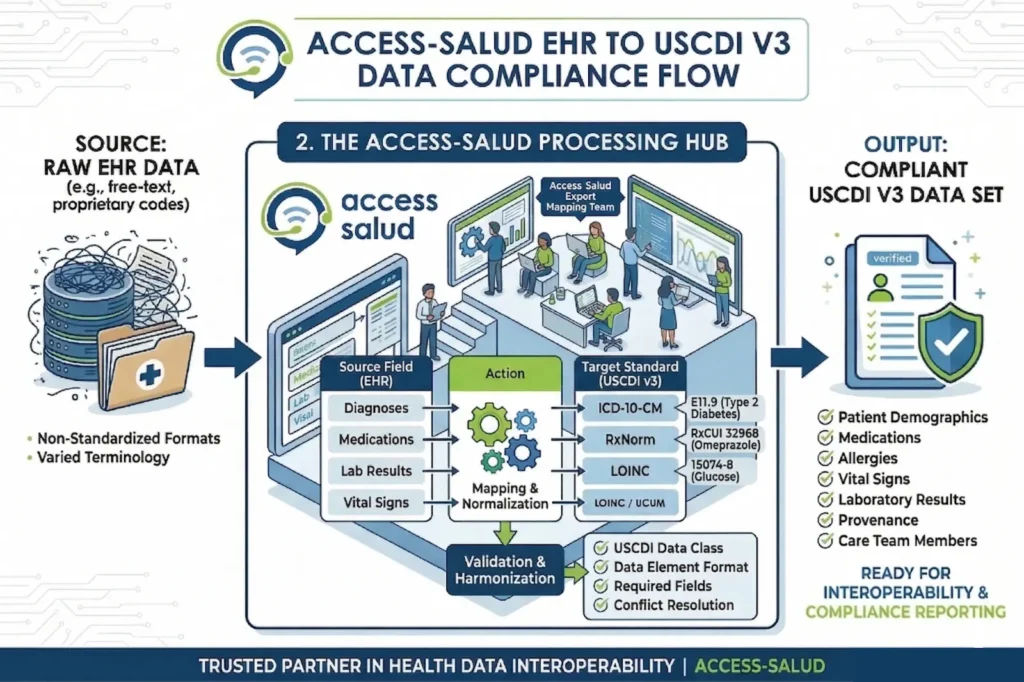
The ‘Invisible Desk’ Strategy
At Access-Salud, we believe that compliance should be invisible to the clinician. While your EHR vendor provides the vessel for USCDI v3, Access-Salud provides the engine that keeps it running.
1. Automated Data Mapping & Validation
Our back-office teams act as your operational layer, auditing intake and billing data to ensure it aligns with USCDI v3 standards before it ever hits a regulatory report. We turn free-text “noise” into structured “intelligence.”
2. Neutralizing the ‘Information Blocking’ Risk
The OIG is now actively investigating complaints. The “Invisible Desk” ensures that patient data requests are handled via modern FHIR APIs with zero friction. We manage the requests, so you don’t have to manage the risk.
3. From Regulatory Burden to Clinical Insight
When data is captured correctly under USCDI v3, it stops being a “task” and starts being a “tool.” Our analytics team uses this high-fidelity data to provide you with insights into patient outcomes and social determinants that were previously hidden in unorganized files.
Conclusion: Authority in a Connected Era
The 2026 compliance horizon is bright for those who have the right architecture. By offloading the technical weight of USCDI v3 to the Access-Salud Invisible Desk, you aren’t just staying compliant—you are reclaiming your time for the “Human Engine” of healthcare.
Is your practice HTI-1 ready? Schedule a Consultation with Access-Salud today.