
Healthcare call center services often shape a patient’s first experience with a healthcare organization. A patient may call to schedule an appointment, ask about a bill, request a prescription refill, or understand what happens after a visit. What feels like a routine call to the organization may be an important step toward care for the person on the other end.
If the patient waits too long, is transferred repeatedly, or leaves without a clear answer, the problem doesn’t necessarily end when the call does. They may call back, miss a next step, or need another team member to pick up the request. For a busy healthcare organization, that can mean more work for front-desk and clinical staff—and more time spent managing avoidable friction.
Healthcare call center services can help connect patients to the information and support they need while giving healthcare teams a more organized way to manage demand. The key is to look beyond how quickly a call is answered and ask what happens throughout the entire interaction.
Patient calls in healthcare operations
A call can reveal where an organization’s processes are working—and where they are creating extra work. Common sources of frustration include long waits, repeated transfers, unfamiliar medical or insurance terminology, language barriers, and uncertainty about who will follow up.
For patients, these obstacles can make a simple request feel difficult to navigate. For staff, repeated calls and incomplete handoffs can add to an already demanding workload. A request that moves between several people without a clear owner can consume time at each step.
That time has a financial dimension, too. When staff repeatedly gather the same information or track down unresolved requests, the organization uses capacity that could be spent on other work. Adding people may be necessary when demand exceeds capacity, but it is also worth examining whether unclear processes are generating work that keeps coming back.
The Agency for Healthcare Research and Quality identifies clear responsibility, information sharing, and follow-up as important care coordination activities. The same principles offer a useful lens for reviewing the administrative journey around a patient call.
What healthcare call center services can support
The exact scope varies by organization, but call center teams may support tasks such as:
- Helping patients’ book, confirm, or reschedule visits and understand the next administrative step.
- Answering routine questions or directing patients to the right department when a request needs another team’s attention.
- Documenting and routing requests, including a prescription refill request, according to the organization’s established process.
- Helping patients keep track of appointments or checking the status of requests that were not completed during the initial call.
- Helping manage demand when the internal team is busy or unavailable.
How to evaluate your healthcare call center: an operations checklist
Before adding capacity or changing a workflow, bring patient-access, front-desk, and clinical representatives together to review a sample of calls and open requests. Use these questions to identify where work is getting stuck:
- Demand: What are the most common reasons people call? When does demand exceed available capacity? Review call volume by reason and time of day alongside staffing schedules.
- Repeat calls: Which requests lead patients to call back, and why? Review repeat contacts and examples of unclear instructions or unresolved requests. Distinguish a legitimate follow-up from avoidable repetition.
- Transfers: Where are calls transferred, and what prevents the first team from helping or escalating appropriately? Check routing instructions, access to information, and staff permissions.
- Delegation and escalation: Which administrative tasks can be handled by trained support staff, and which require a clinician or another authorized team? Review protocols with clinical and compliance leaders before changing responsibilities.
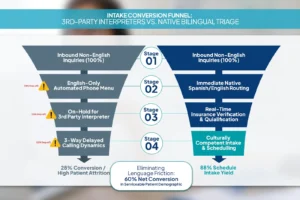
- Bilingual communication: Can patients describe their needs, understand the answer, and confirm the next step in their preferred language? Check how staff access language assistance beyond the languages they speak.
- Follow-up: When a request remains open, who owns it, by when, and how will the patient be updated? Review outstanding requests and handoffs for a defined owner and next action.
- Privacy and quality: Are staff following the organization’s procedures for verifying identity, accessing information, and protecting patient data? Review practices with the appropriate privacy and compliance leads.
How to start
Start with one recurring source of friction. For example, if patients frequently call back about refill requests, map how those requests are recorded, routed, and tracked. Clarify who owns each step, agree on when and how patients will receive an update, and review the process again after a defined period. If the remaining demand still exceeds capacity, consider adding support where it is needed.
A few measures can help teams monitor progress: call volume by reason and time of day, the proportion of calls abandoned before an answer, repeat contacts for the same request, and the number and age of open requests. Define each measure consistently and compare it with your own baseline; a number is most useful when it leads to a specific question or action.
Access-Salud’s approach: connecting operations and care
Access-Salud provides bilingual, culturally sensitive healthcare call center services designed for healthcare organizations. Its team can support appointment scheduling, medical and administrative requests, and follow-up, working with the organization’s existing processes and direction.
As a nearshore healthcare operations partner, Access-Salud aims to act as an extension of the client’s team—not simply as a separate group answering phones. That means connecting patient communication with the workflows and people responsible for the next step.
Every call is an opportunity to make healthcare easier to navigate. By looking at the full journey—from the first question to the final follow-up—healthcare organizations can identify where patients need clearer support and where their teams need a more reliable process.
Have questions about how call center support could help your organization? Contact our team.